

You're halfway through a match you meant to leave ten minutes ago. The next round is already queued, your alarm is set, and you're bargaining with yourself about one last game. You don't need to decide tonight that you'll never play again. You need a boundary that was set before the queue appeared.
The steps here work on any device. TiedSiren is a free app for Android phones running Android 8.0 and later; if you use an iPhone or computer, keep the same window and log, and choose a blocker for your platform.
When One More Match Becomes the Whole Night
You planned to stop after one match. Then another round loads before you put the phone down. The problem is the timing of the decision: you're choosing whether to stop while the next game is already available. Set an end point before you start, so stopping doesn't depend on a fresh negotiation after every match.
Frequent play alone doesn't establish a disorder. The World Health Organization distinguishes gaming disorder by impaired control, gaming taking priority over other activities, and continued play despite negative consequences. Its overview reports that estimates for problem gaming, a proxy rather than a direct measure of gaming disorder, range from 1.3% to 9.9% across populations and jurisdictions. Definitions and assessment methods differ, so those estimates aren't directly comparable. (WHO overview of addictive behaviours)
Treat the pattern as a termination problem you can bound, not a choice between unlimited play and quitting forever. Choose a no-game window that protects the part of the day gaming is disrupting, then track whether you keep it and what changes in your sleep, work, study, or other commitments. Set a block before the risk period and decide what you'll do during that window. If play still runs past the boundary, adjust the timing or the stopping point, rather than relying on a promise made mid-session.
Pick the No Game Window You Can Keep
The first target should be the part of gaming that's costing you something, not an ambitious promise to stop playing altogether. A 2025 systematic review and meta-analysis covering 149,601 young adults aged 18–35 estimated pooled internet-gaming-disorder prevalence at 6.1%, rising to 8.1% in gamer-only samples. Those figures don't diagnose an individual player. They support taking repeated loss of control seriously without treating regular gaming as a problem by itself. (2025 review of internet gaming disorder among young adults)
Use the pattern below to choose a first window. Start with one row, not a full set of restrictions.
| Pattern | First window | Leave alone at first | Success signal |
|---|---|---|---|
| Stops only late at night | Evening hour through morning | Daytime and weekend play | Sleep starts earlier within two weeks |
| First action after waking is a game | Wake time until a fixed start time | Evening play | Work or class starts on time five days a week |
| Weekdays lose study or work hours | Those weekday hours only | Weekend sessions | Planned blocks are kept, weekend play stays unchanged |
| Sessions are fine but always run long | One daily cap, after a fixed window exists | Play inside the remaining time | Minutes fall and you still stop at the planned endpoint |
| Several life areas have been crowded for months | The shortest realistic daily no-game block | Total abstinence | Fewer missed obligations before any wider cut |
Late-night play: If stopping works in the afternoon but fails after a certain evening hour, block games from that hour until morning. Keep daytime and weekend play as it is for now. The first measure is whether you get to sleep earlier, not whether your weekend total goes up or down.
Gaming right after waking: If a game comes before getting ready for work or class, set the block to cover the time between waking and your chosen start time. Leave evening play alone at first. The boundary has done its job when you start work or class on time, rather than when you've reduced every gaming session.
Weekday displacement: If study or work keeps losing time on weekdays but weekends are manageable, cover only the hours you need for those obligations. Don't restrict weekend sessions as well unless the weekday test gives you a reason to widen the boundary.
Sessions that run long: Add a daily minute cap only after you have a fixed no-game window. A cap by itself is easy to renegotiate mid-match, so use it to shape play inside the time that remains, not as the only line of defence. If gaming is crowding out several areas of life, start with the shortest daily block you can keep. Trying to leap straight to total abstinence may give you a rule you can't sustain.
More self-control in the moment is a weak design when the decision keeps arriving during a match. Decide the boundary earlier, then make it harder to revise once the urge hits. Circle one row now, and use that as your first test.
Loss of Control Versus a Bad Week
A rough week of late matches isn't enough to label yourself with a disorder. The World Health Organization's ICD-11 describes gaming disorder through three patterns: impaired control over gaming, increasing priority given to gaming over other interests and daily activities, and continuing or escalating gaming despite negative consequences. A diagnosis also requires significant impairment in important areas such as family, social life, education, work, or personal functioning. The pattern would normally need to be evident for at least 12 months. (WHO's ICD-11 gaming disorder guidance)
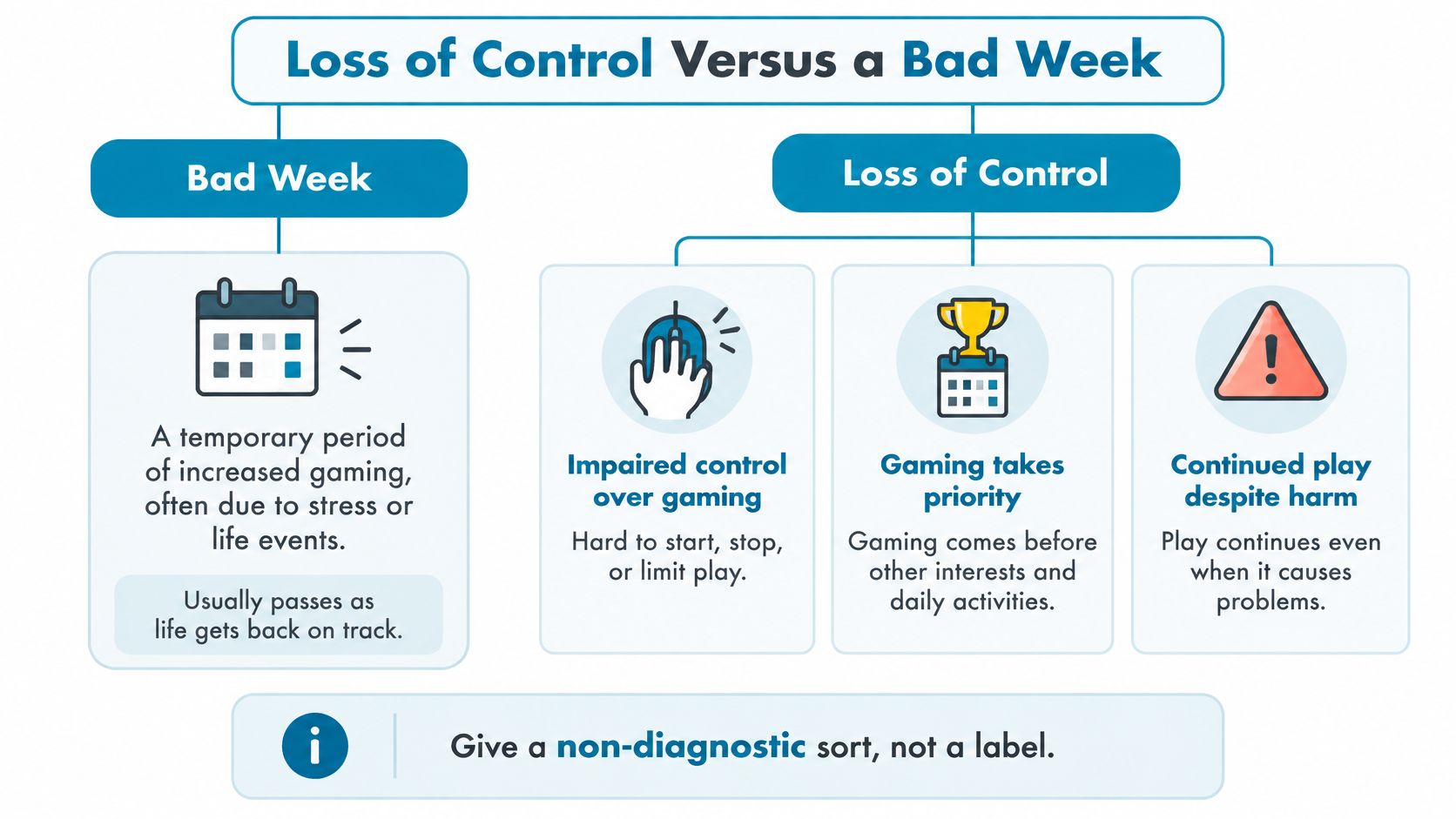
Use the criteria as a way to describe what's happening, not to diagnose yourself. Look at the pattern across situations and over time.
Stopping fails mainly at night: Start by checking whether the problem clusters around late hours and tiredness. An evening block is a practical test of that pattern. If it helps you get to bed earlier and keep daytime responsibilities intact, that's useful information, not a diagnosis.
Gaming crowds out obligations in several settings: If play repeatedly takes time from school, work, relationships, or responsibilities at home, and the pattern shows up both morning and night, pay attention to the impairment. A bad weekend doesn't tell the whole story; persistent disruption across settings deserves more attention.
Other interests fall away or mood is worsening: If you've abruptly lost interest in almost everything outside gaming, or you're also dealing with low mood, anxiety, or ADHD-like impulsivity, don't assume a stronger blocker is the whole answer. A 2025 clinical commentary notes that adolescents with ADHD, anxiety, or depression are at heightened risk of addictive screen tendencies, and gaming may serve as avoidance, stimulation, or mood regulation. (American Family Physician commentary on digital dependency)
If sleep, relationships, work, school, or safety keep getting worse after you try a narrow boundary, book an appointment with a qualified clinician. Bring your weekly notes on minutes played, sleep, missed obligations, and how long each pattern has lasted. Worsening mood, anxiety, or impulsivity is a reason for that visit, not a cue to keep stacking blockers.
How to Run a Four Week Cutback
Treat a cutback as a measurable test, not a contest in willpower. Keep the first change narrow enough that you can tell whether it helped.
Write one target sentence. Make the rule concrete: “No games after my chosen evening hour,” or “No games until the work block ends.” Don't add a second target yet. A narrow rule shows whether the boundary you chose addresses the trouble.
Record a seven-day baseline. Before changing your routine, note minutes played, number of gaming episodes, what triggered each session, when you slept, and each time you tried to quit but continued. Triggers might include boredom, losing a match, a friend joining voice chat, or a game notification. Write down the facts without trying to make the week look better or worse.
Set the block before the risk window. Block the specific game apps during the period you've chosen. If you're using a blocker on Android, start the session before that period begins and avoid renegotiating while it's running. The point is to make the decision while you're calm, not after the client is open and another match is available.
Choose one replacement activity. Pick something you can begin within a couple of minutes when the urge arrives: step outside for a short walk, wash a few dishes, do a brief workout, or put on a saved show that has a clear stopping point. Keep the alternative ready. A vague plan to “do something else” leaves a gap that the game can fill.
Review once a week for four weeks. Compare minutes played, number of episodes, sleep duration, and the number of scheduled blocks you kept. Also note whether gaming continued to displace study, work, or relationships. If you bypass a block, record when it happened and what triggered it. Treat that as a protocol miss to understand, not evidence of a character flaw.
Structured psychological treatments have evidence behind them, though a self-management experiment isn't a substitute for care when serious impairment is present. A meta-analysis found large reductions in gaming-disorder symptoms versus inactive controls (SMD = 1.70, 95% CI 1.27–2.12) and moderate-to-large reductions versus active controls (SMD = 0.88, 95% CI 0.21–1.56). Combined cognitive-behavioral therapy and mindfulness ranked most effective, followed by CBT with family intervention, mindfulness alone, and CBT alone. (Meta-analysis of psychological treatments for internet gaming disorder)
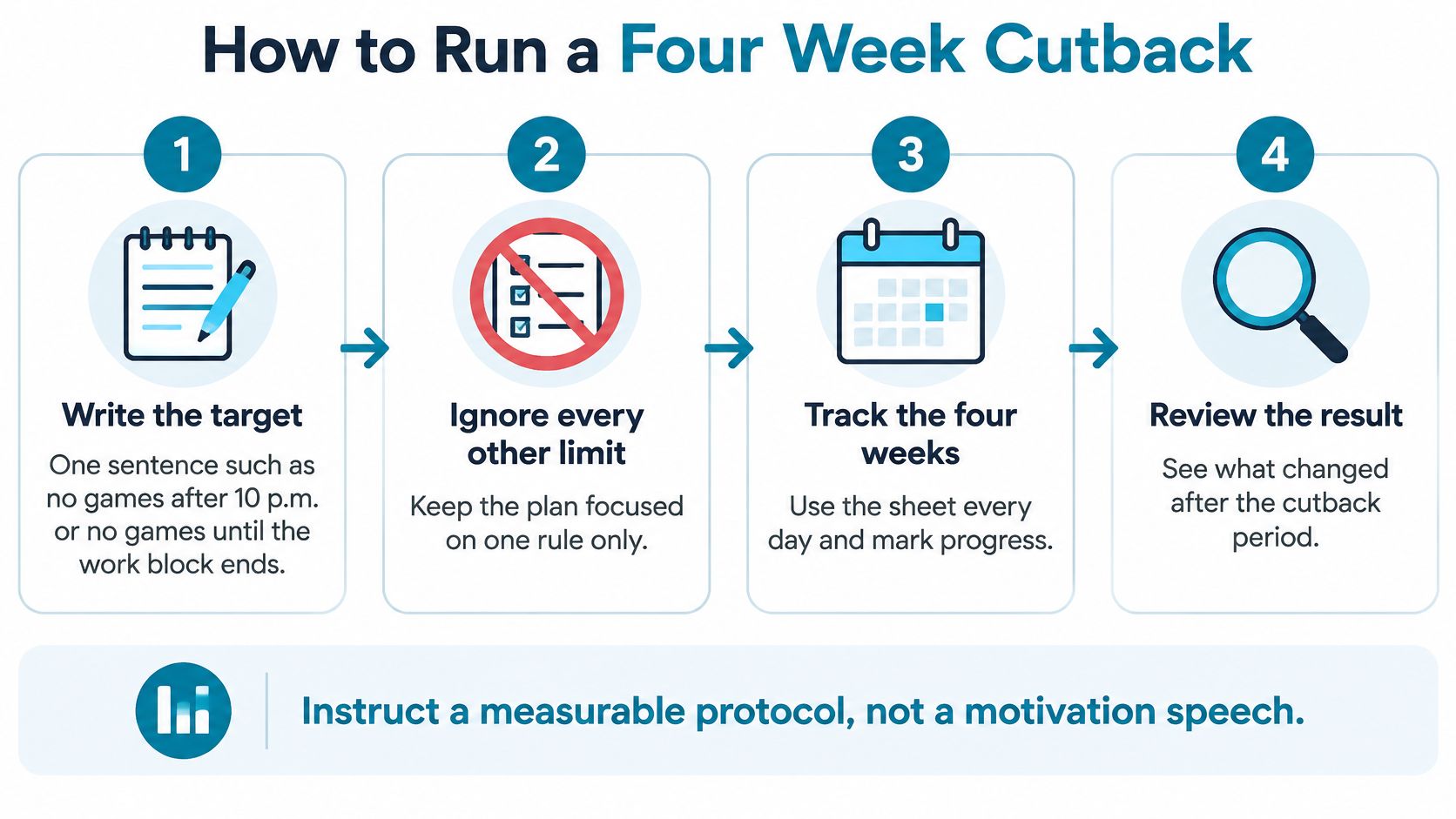
A shorter total can hide the same stopping problem. If minutes drop but you're still missing obligations or losing sleep, the change hasn't solved the issue that matters. Keep the weekly sheet focused on function as well as time. Four weeks can tell you whether the window is workable; it can't establish a diagnosis.
Tips for the Night the Queue Comes Back
A rough day, a party invite, and one more match can push a workable limit into another late night. Set a clear end time before the queue opens, then judge the plan by whether you stop on time and keep your obligations, not by whether you avoid gaming altogether.
A 2025 systematic review and meta-analysis of gaming-disorder interventions found post-intervention reductions in gaming-disorder symptoms (g = 1.38) and gaming time (g = 0.90), alongside improvements in depression (g = 0.65) and anxiety (g = 0.66). At 90-day follow-up, effects remained substantial for symptoms (g = 1.15) and gaming time (g = 0.79). Keep the same log for 4–12 weeks to compare the restriction period with the time you maintain or loosen it.
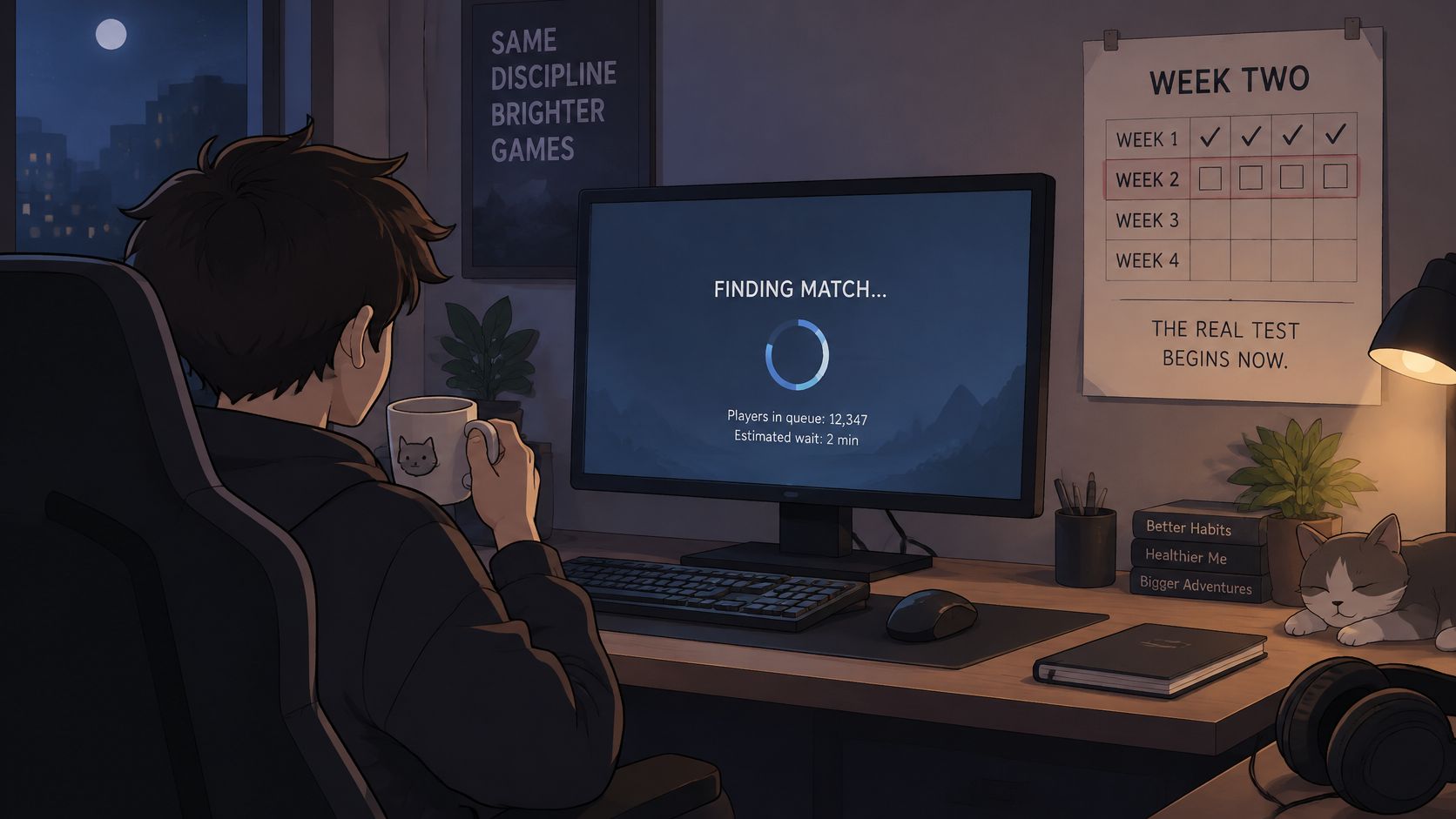
When the urge returns, keep the boundary you set rather than adding time because the day went badly. Put a replacement activity within reach: leave your shoes by the door, unplug the controller, or choose a task you can start without planning. If you tend to keep playing in bed, move the charger away so continuing means getting up.
Tell one person the hours you're keeping. A party invite then has a clear answer, and friends know when you're available. If gaming is where most of your social life happens, arrange a voice or in-person catch-up during the hours you've left open. The aim is to bound play, not cut off every connection.
If gaming starts creeping back, adjust one part of the setup. Start the block earlier, or make the replacement activity more specific, while keeping your original target. Changing the window, replacement, and measure at once makes it hard to tell which adjustment helped.
Published estimates of problematic gaming vary widely across countries and measurement tools. There's no universal success rate that can set your target. Use a practical benchmark instead: fewer gaming minutes and fewer missed obligations, with both gains continuing when scheduled restrictions ease.
Lock the Games on Android Before You Queue
The familiar failure is a blocker you turn off as soon as the match invite arrives. The core problem may be stopping at the moment you intended, not a lack of knowledge about screen time. The ICD-11 framework treats control over the timing, frequency, intensity, duration, termination, and context of gaming as relevant. A session whose duration is set in advance gives you an endpoint to follow rather than another decision to make mid-match. (Review of gaming-disorder assessment and classification)
For Android 8.0 and later, TiedSiren is a free app blocker. You choose the applications to block and commit to a duration before the session starts. Its Strict Mode means a running session ends when its timer ends, and nothing else ends it. The app also blocks the Android Settings screen while a session runs, which raises the cost of the impulsive undo. That creates friction against a quick bypass; it isn't a claim that no determined person could ever get around a block.
Custom blocklists let you group games by context, such as sleep or study. Scheduled sessions can recur daily or weekly, so a predictable window doesn't depend on making a fresh decision each day. A focus timer shows how much time remains in the session. The TiedSiren feature overview describes how these tools support app blocking without turning every moment of temptation into another negotiation.
A blocker you can switch off in three taps is not a commitment device.
AppBlock, BlockSite, Cold Turkey, and Stay Focused also block solidly. The relevant distinction here isn't a claim that TiedSiren blocks better. It's that a TiedSiren session has no override during the session. That can make it harder to act on an impulsive urge, while still leaving the broader question of sustained loss of control to be addressed on its own terms.
If you use an iPhone or computer, apply the same no-game window with a tool for your platform. If you're on Android and ready to try a committed session, get TiedSiren on Google Play or download TiedSiren. Start tonight's window before you open the game, then keep the weekly log.
TiedSiren is a free Android app blocker that lets you choose the apps to block and commit to a duration in advance. If you're ready to make tonight's gaming boundary harder to renegotiate, visit TiedSiren.