
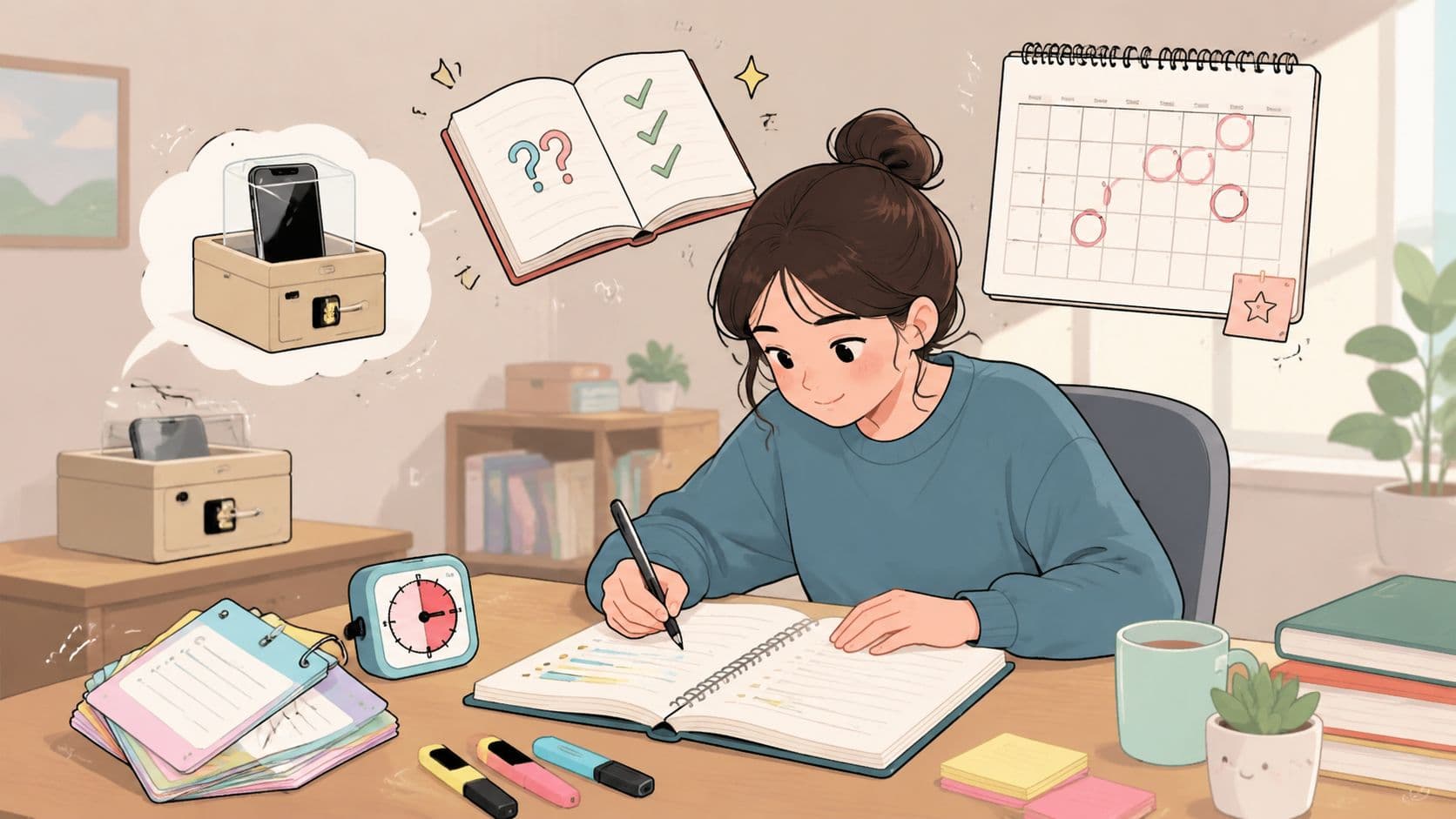
Most advice about how to study faster gets the problem backward. People keep talking about reading speed, prettier notes, and cleaner highlighters, then act surprised when the material won't stick the next day. The bottleneck usually isn't how fast you move your eyes across a page. It's whether the material survives long enough in memory to matter, and whether your own phone or habits break the session before you get there.
A better standard is simple. Studying faster means wasting less time, not rushing more. If a method helps you remember more with less rework, it's fast. If it only makes the session feel busy, it's mostly theatre.
Why Most Study Advice Fails
Most study guides treat speed like a reading problem. They recommend rereading, color-coding, Pomodoro timers, and tidy note systems that look productive but leave recall untouched. That can make a desk feel organized. It does nothing if the material falls out of memory as soon as the session ends.
The primary bottleneck is usually earlier. Students often disable the very systems that would protect the session, then blame themselves for weak focus later. They check one message, open one tab, or let a small interruption turn into a reset. Once that happens, the study block becomes fragmented, and the clock keeps running.
Research backs the basic point. A large 2026 meta-analysis in medical education found that spaced repetition outperformed standard studying across 21,415 learners, with a standardized mean difference of 0.78 and strong evidence against cramming as an efficient default (PubMed). An older meta-analysis on distributed practice found 63 studies and 112 effect sizes, with an overall mean weighted effect size of 0.46 favoring spaced study over massed practice. Those findings matter because they show where time is wasted, repeating work that never sticks.
The hidden waste in a bad study session
Rereading feels easy because it asks almost nothing of you. That is the problem. Recognition is cheap, retrieval is hard, and retrieval is what builds memory you can use.
Practical rule: If a study method never makes you close the book and pull the answer from memory, it is probably helping you feel busy more than helping you learn.
A lot of students also lose time to attention drift. They sit down for an hour, then spend pieces of that hour checking messages, opening tabs, or recovering after each distraction. That kind of fragmentation turns a short session into a long one. Faster studying starts by removing those leaks.
Spaced Repetition and Why It Works
Spacing works because memory drops after first exposure. If you come back too soon, you mostly rehearse familiarity. If you wait until some forgetting has started, you have to rebuild the path, and that rebuild is what makes later recall easier. The point is not constant review. The point is to review after the material has cooled off a bit.
The useful part of the research is simple. A 2025 review on spacing found consistent retention gains from spaced practice, and the earlier distributed-practice meta-analysis pointed in the same direction with 63 studies and 112 effect sizes (Donovan and Radosevich PDF, Murray et al. PDF). That is why a review the next day, then a few days later, then again after a longer gap usually beats one long cram session. You are making the brain recover the material instead of relying on short-term familiarity.
A simple interval pattern that doesn't overcomplicate things
For near-term exams, keep the schedule plain. Review soon, review again after some delay, then review once more close to test day. Do not keep stretching the gap just because it sounds advanced. The review on retrieval practice did not support the idea that intervals need to grow forever, so a simple repeatable spacing pattern is usually the better trade-off. It is less clever and more usable.
| Days Until Exam | Review Interval 1 | Review Interval 2 | Review Interval 3 | Expected Retention Gain |
|---|---|---|---|---|
| 1 to 7 | Same day or next day | A few days later | Right before the exam | Better recall than one long cram |
| 8 to 21 | Next day | Around a week later | A final pre-exam review | More stable recall under pressure |
| 22 or more | Next day | One week later | Two to three weeks later | Stronger long-term retention |
The table looks plain because the method is plain. That is part of the point. Most students want a trick that feels smarter than it is, then abandon it when they get tired or distracted. A repeatable spacing pattern survives bad days, which is when studying usually breaks down.
Active Recall in Practice
Active recall means pulling the answer out of memory without staring at the source material. That's the work. If you can only answer once you see the cue, you're not testing memory, you're testing recognition. The friction matters.

Turn material into prompts that force retrieval
Textbook chapters work better when they become questions. Headings can become prompts. Definitions can become flashcards. Summaries can become a blank page exercise where you write what you remember, then check what you missed.
For biology, that might mean “What does this organelle do?” instead of highlighting the paragraph. For programming, it's “Write the function from memory, then explain each line.” For a professional certification, it's “List the steps, then name the exceptions.” The shape changes, but the rule doesn't. You need a prompt that makes your brain produce the answer before you see it.
A clean workflow looks like this:
- Close the source first. Don't peek while you think.
- Write or say the answer from memory. Short answers are fine if they're honest.
- Check immediately. Correct the missing parts while the error is still obvious.
Real recall should feel a little uncomfortable. If it feels too easy, you probably built the prompt around recognition.
Keep the prompts honest
Multiple-choice questions can help at the beginning, but they can also let you guess your way into confidence. Flashcards with hints can do the same thing. The better card usually asks for one answer, one fact, or one process. One card, one target.
That matters because the goal isn't to collect cards. It's to expose what you can't yet retrieve. A short, difficult recall session is more useful than a long session where you keep nodding at answers you half-recognize.
The Phone Problem and Physical Removal
Silencing notifications isn't enough when the phone is still on the desk. The problem isn't only interruption. It's the fact that the device remains available at the exact point where your judgment gets weaker. The 2025 study on smartphone absence found that being away from the phone improved flow and learning performance, with nomophobia moderating the effect (Taylor and Francis study). That points to a blunt conclusion. Distance matters more than a quiet device.
The systematic review of digital self-control interventions points in the same direction. Awareness-only approaches were barely effective, and the overall confidence in the results was low because of small samples, short study duration, and unclear contexts (Wiley review). In plain terms, reminders are weak. Friction works better than intention.
Make the phone inconvenient before you start
The fix is environmental, not motivational. Put the phone in another room. Leave it with someone else. If you have to keep it nearby, make access annoying enough that the impulsive tap doesn't happen automatically. If your blocker only sends you a warning, it's still negotiating with the exact version of you that's tired and impatient.
Practical rule: If you can reach the phone without standing up, it's still part of the study space.
That's why physical removal beats “Do Not Disturb” habits for a lot of people. A silent phone still sits there. A hidden phone has to be fetched. That extra step is often the difference between finishing a study block and losing twenty minutes to a feed.
A free Android option for creating that kind of friction is TiedSiren, which blocks apps you choose for a duration you commit to up front and can block the Android Settings screen while a session runs. It doesn't solve self-control for you. It raises the cost of the impulsive undo.
| Phone Placement | Working Memory Impact | Task Performance Change | Recommended Action |
|---|---|---|---|
| On the desk | Highest distraction pressure | Learning suffers most | Move it out of reach |
| In another room | Lower temptation | Better sustained focus | Use this during study blocks |
| With another person | High friction to access | Less likely to check it | Best when you keep relapsing |
| Off but nearby | Still distracting | Still costs attention | Treat as insufficient |
The table is the lesson. The phone doesn't need to ring to cost you focus. It just needs to be available.
Enforced Focus Sessions That Hold You Accountable
A timer you can dismiss is a suggestion. A session with real friction is a commitment. That difference matters more than people want to admit, especially when they already know what to do and still open the app anyway.

Build the session around a decision you made earlier
Pick the task before the session starts. Set the duration. Then make leaving the session annoying enough that you don't do it on impulse. That can mean a locked app, a blocker with no easy override, or a timer that sits across the room so stopping it requires effort. The point is not punishment. The point is to move the decision away from the moment of weakness.
Sessions also need to match the work. Shorter blocks fit rote memorization. Medium blocks work better for problem sets. Longer blocks fit reading or writing that needs momentum. If the block is too long, you'll drift. If it's too short, you'll spend the whole day starting over.
Don't let the gap between sessions eat the day
The break between blocks is where a lot of good intentions die. People sit down, check something quick, and the study day falls apart. A cleaner approach is to end one session, stand up, move around, then start the next one at a set time. That keeps the break real without turning it into a distraction tunnel.
The features page shows the core mechanics of TiedSiren in plain terms, including Strict Mode, scheduled sessions, custom blocklists, and a focus timer. That combination fits the study problem because it makes the off-switch less available when you're most likely to reach for it.
A blocker doesn't need to be perfect to be useful. It just needs to stop the quick, stupid exit.
Building a Repeatable Study System
The methods work best when they stop being separate tricks and become one routine. Spaced repetition handles retention. Active recall handles depth. Physical phone removal protects attention. Enforced focus sessions create the container that makes the rest possible.
The daily shape can stay simple. Start with a short review of due material. Then do blocked work on new material with retrieval, not rereading. End by preparing tomorrow's queue so you're not making decisions when you're already tired. The point is repeatability, not elegance.
Match the tool to the task
- Use spaced repetition for facts, formulas, definitions, and anything that decays fast in memory.
- Use active recall for material you need to explain, solve, or reproduce under pressure.
- Use focus blocks when the problem is attention, not understanding.
- Use physical distance from the phone when willpower keeps failing at the same moment.
The system breaks in predictable places. Missed days happen. Some sessions feel flat. Sometimes you'll abandon the routine after one bad week. Don't rebuild the whole thing after a rough day. Restart with the smallest version that still works, one review block, one recall session, one phone-free window. The best study system is the one you can keep using when you're annoyed, behind, or tired.
If you want to study faster, stop chasing prettier notes and start removing the exact moment where you talk yourself out of focus. Build a setup that makes the impulsive exit harder, then use that saved attention for recall and spacing. Try TiedSiren if you want a simple Android blocker that turns study time into a committed session instead of a promise you can cancel in five seconds.