

At 11 p.m., the laptop is open, the document is ready, your headphones are on, and the coffee beside you has gone cold. It looks like work is happening. Then your phone lights up with a notification that's barely relevant. Your thumb opens it before your brain gives permission, and twenty minutes later you're on Reddit, while the laptop is still exactly where you left it.
That five-second window is the problem. The off switch for focus sits one tap away, and willpower is expected to beat an entire device designed to reward interruption. For adults with ADHD, knowing what to do often isn't the missing piece. The practical lever is friction placed before the urge arrives.
The Moment the Willpower Runs Out
I know the scene because I've repeated it. The task isn't impossible. It may even be interesting. But the task offers a delayed payoff, while the phone offers something immediate, novel, and effortless. Once the notification appears, the decision is already tilted.
The failure doesn't feel like a decision. It feels like movement. The thumb opens an app, the feed supplies another item, and the original task becomes harder to re-enter with every second away from it.
The five-second rule: If the distracting option is available immediately, you're asking your weakest moment to make your strongest decision.
That's why “just put the phone down” keeps failing. It treats the problem as information. You already know the phone is distracting. You already know the work matters. You may have installed a blocker before and turned it off precisely when it mattered.
The core issue is the architecture around the choice. The task requires sustained attention, working memory, and repeated decisions about what to ignore. The interruption requires one tap. Those options aren't competing on equal terms.
Adults with ADHD aren't morally less disciplined. The environment makes the wrong action easier at the exact moment executive control is under pressure. A useful focus system changes that environment before the notification, urge, or tired late-night brain gets involved.
The practical work behind TiedSiren's approach starts there. Decide which apps stay unavailable, choose the session duration in advance, and make the impulsive exit more expensive than a casual tap. That won't remove every possible bypass, but it can defeat the impulsive bypass, the one done without premeditation.
Why ADHD Focus Breaks Down Under the Surface
ADHD focus problems involve more than being “easily distracted.” A meta-analysis covering 83 studies, with 3,734 people with ADHD and 2,969 controls, found significant executive-function impairment across tasks, with medium effect sizes ranging from .46 to .69. The most consistent weaknesses involved response inhibition, vigilance, working memory, and planning. The meta-analysis is available through PubMed.
In plain language, the brain has more difficulty keeping the current task active while suppressing competing actions. Think of your desk covered in open tabs. Each tab contains a possible task, worry, idea, or reward. You switch to one, then another, and pay the switching cost each time. By the fifth tab, you may have spent plenty of mental energy without producing the work you sat down to do.
Adult ADHD research also identifies deficits in selective attention, divided attention, and sustained attention, although the pattern isn't identical for every person. A review of adult ADHD attention performance supports treating focus as a measurable control problem rather than a character flaw.
The reward gap matters
Immediate rewards can beat delayed rewards when the task in front of you is boring, ambiguous, or emotionally loaded. Reviews of ADHD neuroscience describe reduced dopamine synaptic markers in the midbrain and nucleus accumbens, with associations to attention measures. Dopamine also modulates prefrontal attention networks across short and longer timescales, which helps explain why focus can collapse during low-stimulation work and become highly selective during urgent or novel work. The neurobiology is discussed in this review.
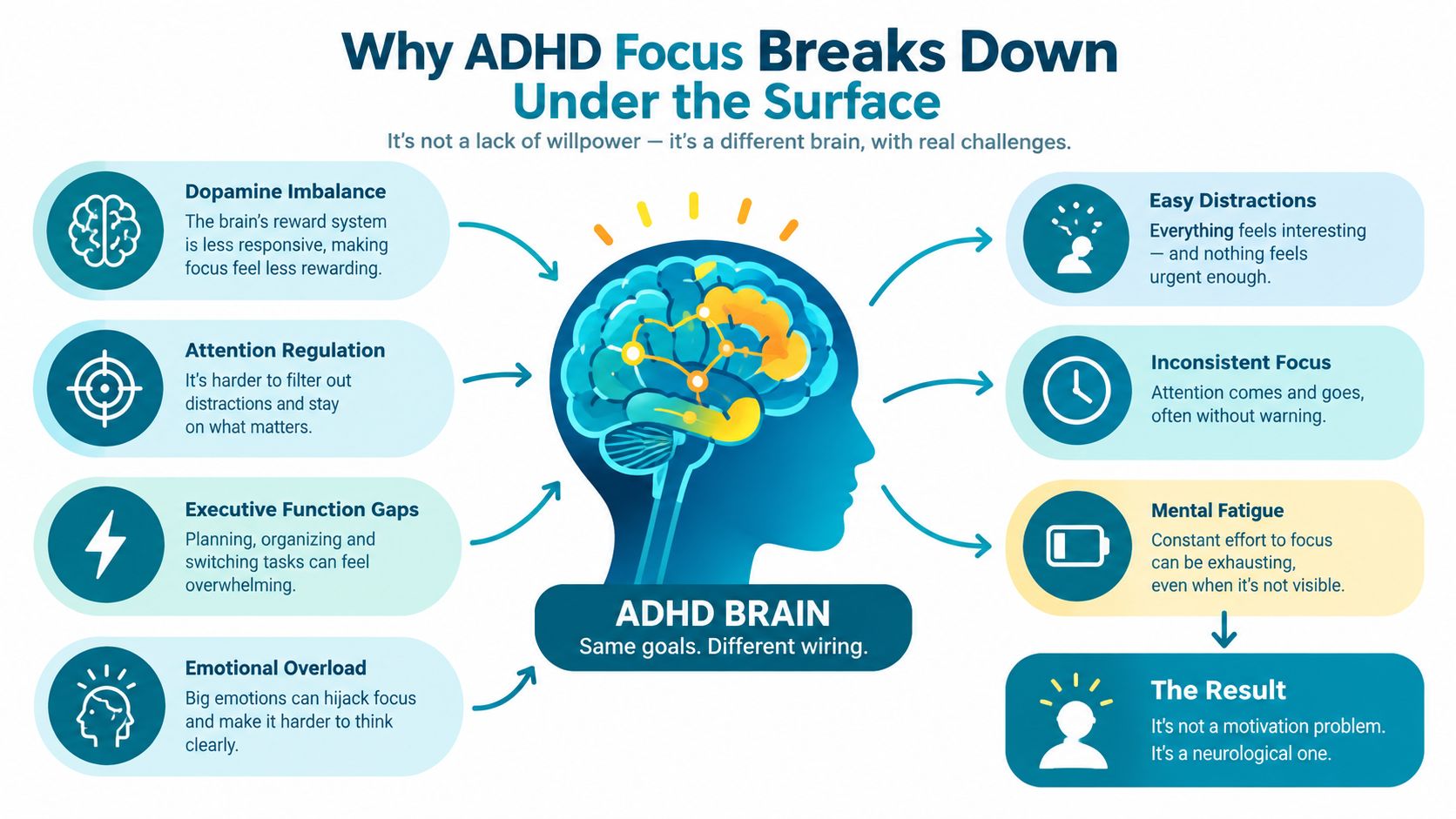
The implication is practical. Telling someone with ADHD to try harder targets inhibition and task maintenance without changing the conditions that drain them. External structure reduces the number of decisions required while the work is underway. It makes the intended action easier to continue and the distracting action harder to start.
Willpower Versus External Friction
Willpower strategies can help when the temptation is mild. A Pomodoro timer, a phone in another room, a motivational quote, or a sticky note can remind you what you intended to do. None of those tools, by themselves, changes who controls the off switch.
At the moment of temptation, the user still decides whether to dismiss the timer, retrieve the phone, ignore the note, or open the distracting app “for a minute.” That's the weakest possible point in the process. The reminder arrives in real time, after the urge has already appeared.
External friction moves the decision earlier. A scheduled block, strict app-blocking session, locked profile, or committed time window establishes the rule before the difficult moment. The urge can still arrive, but it no longer gets an instant negotiation.
| Dimension | Willpower Strategy | External Friction Strategy |
|---|---|---|
| Decision timing | The user decides during the urge | The user decides before the urge |
| Main mechanism | Reminder, intention, or habit | Added steps, blocked access, or a committed window |
| Failure point | The user can usually disable it quickly | The user must work through deliberate friction |
| Best fit | Low-stakes distractions and mild fatigue | Repeated impulsive bypasses and high-risk apps |
| Trade-off | Flexible, but easy to renegotiate | Stronger commitment, but less convenient during the session |
Android's own controls show the basic principle. Google documents a unique 4-digit PIN for app time limits, which creates a separate gate rather than relying only on a reminder. Android's app-limit documentation also makes clear that setup requires access to the device settings.
A reminder competes with the urge. A committed time window has already answered the question.
That doesn't mean stronger enforcement is always better. If a block is too restrictive for the situation, you'll avoid using it. The useful rule is simpler: decide in advance, then make the decision physically harder to undo.
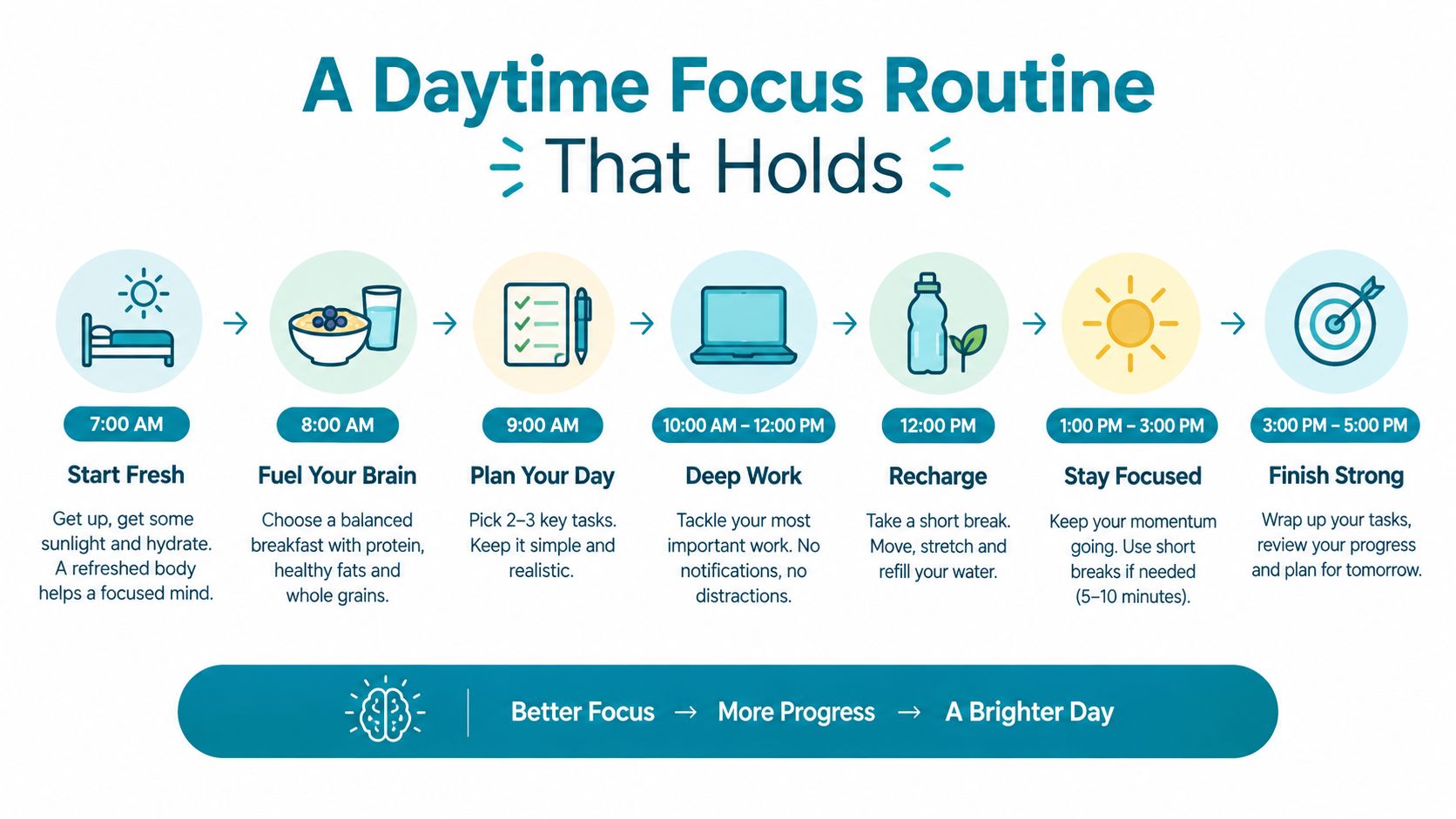
A Daytime Focus Routine That Holds
A workable daytime routine needs a clear start, a defined finish, and fewer choices inside the work period. The following structure uses committed blocks instead of repeated reminders.
Start with a 20-minute setup
Use the same startup ritual each day. Spend 20 minutes opening one task, closing every browser tab except the document or tool required for it, and putting the phone in another room.
Closing the tabs before sitting down matters more than it sounds. If you leave five possible destinations open, you've created five invitations to switch. Remove those invitations while the decision is easy.
Write the first physical action on paper: “Draft the opening paragraph,” “review the first data set,” or “reply to the first client email.” “Work on the project” is too vague to pull attention forward.
Run three 50-minute blocks
Treat each work block like a meeting someone else booked.
- Block one: Start with the smallest clear action and stay with it for 50 minutes.
- First break: Take a 10-minute walk. Don't replace physical movement with scrolling, because the phone becomes the next task.
- Block two: Continue the same project if possible. Re-entry is easier when you don't change context.
- Second break: Walk, drink water, or stand somewhere away from the desk for 10 minutes.
- Block three: Use the final 50-minute period for completion, editing, or the next defined step.
The exact structure isn't sacred. The commitment is. If three blocks are too much on a given day, start with one and protect it properly. A short completed session teaches your brain that starting doesn't require waiting for perfect motivation.
End with a 15-minute shutdown
Spend 15 minutes recording what you finished, closing the work surface, and writing tomorrow's first action on a sticky note. Leave the note where you'll see it when the next startup ritual begins.
The shutdown prevents tomorrow from starting with reconstruction. You aren't asking your tired future self to remember where the work stopped.
For Android users who need the blocking layer to match this routine, TiedSiren's features include custom blocklists, scheduled sessions, a focus timer, and Strict Mode on Android 8.0 and later.
Three Levels of Android Enforcement
Android offers different levels of restriction, and they solve different problems. The mistake is treating a reminder as though it provides the same protection as a committed lockout.
| Tier | Where It Lives | Bypass Difficulty | Best Use |
|---|---|---|---|
| Tier 1 | Settings app timers and Focus Mode | Low, because the user can return to settings and change the limit | Low-stakes daytime distractions |
| Tier 2 | Digital Wellbeing, Bedtime mode, and app timers | Moderate, but the controls remain cancellable from the relevant screen | Regular daytime boundaries and routine support |
| Tier 3 | Strict-mode app blocker with a timed session | Higher friction during the active window, especially when settings access is blocked | High-risk distractions, late-night scrolling, and committed work sessions |
Tier 1 works when you're already willing to cooperate. You open the relevant Settings control, change or remove the limit, and return to the app. That may be enough for an app you only check occasionally. It won't reliably address the moment when you're tired and looking for the fastest possible reward.
Tier 2 gives you a broader system for app limits and Bedtime mode. It adds structure across a routine, but the user can still cancel or change settings from the same general control area. Google also documents app-level blocking through Settings by selecting an app and turning off its allowance. The Android parental-controls guidance describes that route directly.
Tier 3 puts the commitment into a session that is harder to undo casually. A strict-mode blocker can keep the selected apps unavailable for the duration you chose and raise the cost of reaching the off switch. Google Play's Family Link app-limit documentation provides another example of recurring, rule-based app restriction, with blocked apps marked and allowed apps controlled by toggles.
Use Tier 2 for ordinary daytime distractions when flexibility matters. Use Tier 3 for the phone-in-bed problem, the work block you repeatedly abandon, or the apps you already know you'll reopen automatically. TiedSiren's Android download page describes a free app for Android 8.0 and later that uses timed sessions, custom blocklists, recurring schedules, and a settings-screen block during active sessions.
How Scheduled Sessions Change the Evening
Take the same Tuesday at 10:30 p.m.
On the first version of the night, you're tired but not ready to sleep. Reddit is one swipe away. You open it to check one thread, then YouTube supplies the next choice. The phone doesn't need to persuade you with a dramatic decision. It only needs to keep presenting the next low-effort reward.
The laptop remains open, but the workday is over. You've spent the available attention on re-entering feeds instead of preparing for sleep or finishing the small task you meant to complete.
Now change the setup, not the person. A scheduled session begins at 10 p.m. and runs through the night. The distracting apps are blocked for the committed window, the focus timer shows the remaining time, and reaching the Android Settings screen requires more deliberate effort because the active session blocks it.
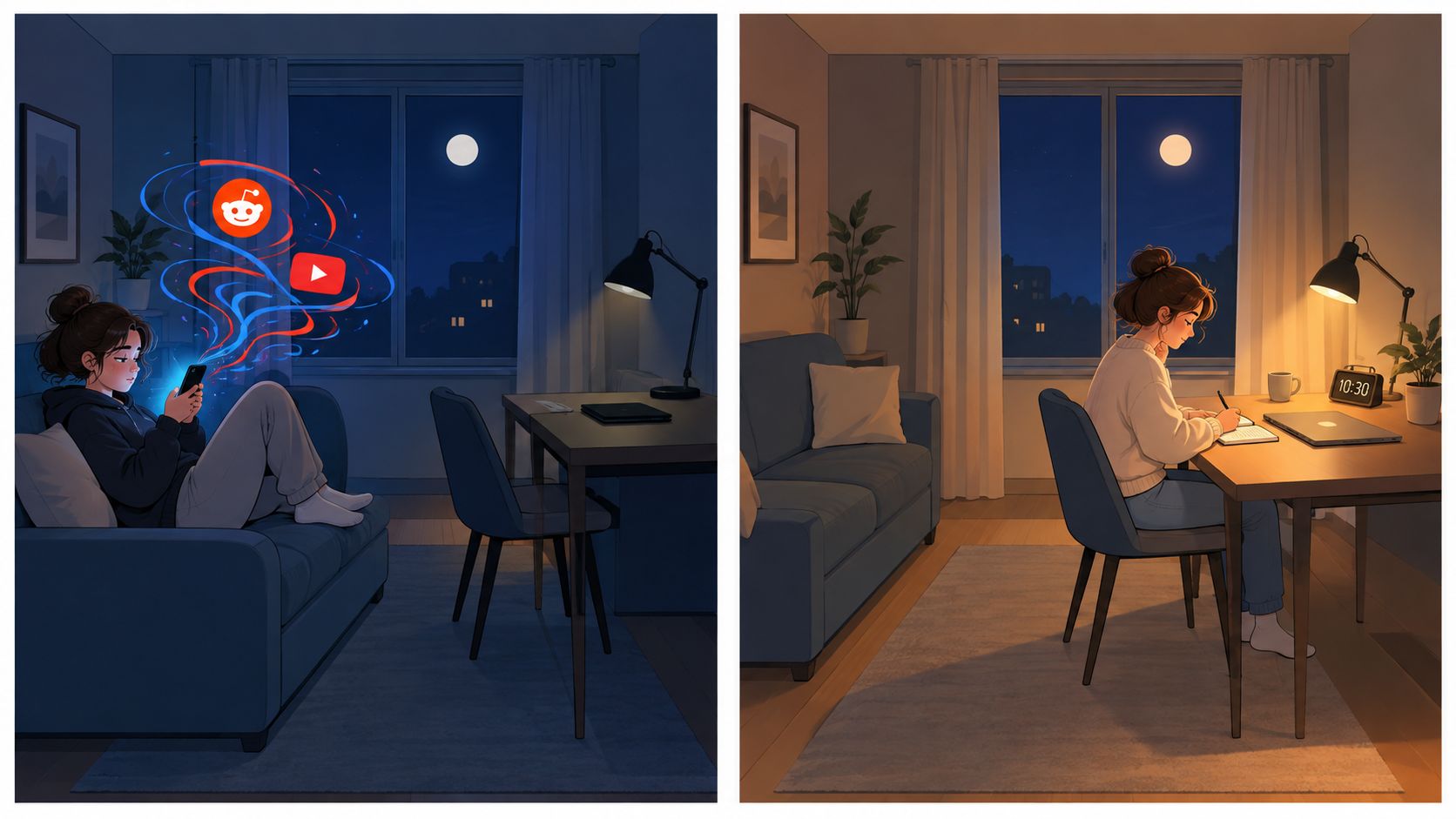
At 10:30, the urge still appears. That part hasn't been fixed. The difference is what happens during the next five seconds. Instead of opening the feed immediately, you meet a barrier that reflects a decision you made earlier, when you weren't exhausted and bargaining with yourself.
Scheduled enforcement works because it refuses on your behalf before you need to refuse.
This is friction, not an absolute lock. Someone who plans a determined bypass may still find another route. The point is narrower and more useful: remove the effortless route that wins by default.
The same design transfers to daytime work. A session can begin before the first meeting, cover a study period, or protect the part of the morning when you need to write. The system doesn't make the task interesting. It keeps the competing action from being immediately available.
Three Myths That Keep ADHD Adults Stuck
Myth one, ADHD means being more distracted than everyone else
That description is too blunt to be useful. Adults without ADHD also lose an evening to a phone. The more relevant difference is regulation, including how long attention remains stuck after it shifts and how difficult it is to disengage.
Recent visual-search evidence found longer fixations and more refixations on distractors among adults with ADHD, supporting a “stuck on distraction” pattern rather than a simple claim that they always notice more distractions first. The study is available in this PMC article.
Myth two, better sleep fixes ADHD focus
Sleep matters. Poor sleep can make attention and impulse control harder for almost anyone. But better sleep doesn't automatically create a pause between sitting down and opening Instagram.
The relationship between ADHD symptoms, problematic social media use, and sleep is more complicated than raw screen-time advice suggests. A 2024 study associated problematic social media use with poorer sleep quality and higher ADHD symptoms, while total social-media time wasn't linked to sleep quality. The study's findings are reported here.
Myth three, a blocker is useless if it can be bypassed
A blocker that disappears after a casual tap isn't useless. It may stop an automatic check or create enough interruption for you to reconsider. Stronger friction has a different job: it defeats the impulsive bypass.
| Common Myth | What Sounds Right About It | What Is Actually Happening |
|---|---|---|
| ADHD adults are simply more distracted | They may appear to switch constantly | The harder problem can be inhibiting the switch and disengaging afterward |
| Sleep solves the focus problem | Rest improves baseline functioning | Sleep can help without removing the need for external structure |
| A bypassable blocker does nothing | A determined person can find a route around it | Added steps can stop the unplanned, five-second reversal |
Change the belief before changing the tool. Focus with ADHD isn't a test of whether you can remember the right advice. It's a design problem involving task maintenance, reward timing, and the number of decisions left available during the urge.
Putting the Pieces Together This Week
Don't rebuild your entire life on Monday. Pick three moves and run them for seven days.
First, put two 50-minute committed sessions on the work calendar each day. A calendar block is stronger than a to-do-list item because it gives the task a time and a boundary. Keep the phone in another room, or place it behind a strict mode profile that creates a deliberate wait before access.
Second, choose one enforcement tool that matches your actual bypass history. If you've repeatedly dismissed reminders, use a stricter session rather than collecting more reminders. If a full lockout makes you avoid the routine, reduce the blocked app list or shorten the first commitment until you'll start it consistently.
Third, schedule a sleep session that blocks the apps most likely to pull you into compulsive use at bedtime and continues until morning. The relevant target is the usage pattern that keeps reopening the reward loop, not an abstract goal to reduce every minute of phone use.
Add a two-minute reset at the end of every protected session:
- Record the stopping point: Write the exact next action.
- Clear the surface: Close unrelated tabs and put materials where you'll see them.
- Restore the room: Move the phone back only after the session ends.
- Confirm the next block: Check the calendar instead of negotiating with a vague intention.
After seven days, audit the system without turning the audit into self-criticism. Which sessions held? Which app pulled you out? Did the barrier stop the first impulse, or did you spend the session looking for a route around it?
Keep what held. Change what broke. The useful system has three layers: a calendar commitment on the outside, friction in the middle, and a short shutdown that keeps tomorrow from starting behind.
TiedSiren is a free Android app for committed blocking sessions, with custom blocklists, recurring schedules, a remaining-time focus timer, Strict Mode, and a blocked Android Settings screen during active sessions. If your main failure happens in the five seconds after an urge hits, visit TiedSiren and set up one focused work or sleep window before the next impulse arrives.