
You install an app blocker, choose the apps that keep stealing your attention, and commit to a focus session. For a while, the decision feels solid. Then the urge arrives, you open the settings screen, and five seconds later the blocker is off. The work is still waiting, but now you've lost the time and the confidence you had when you started.
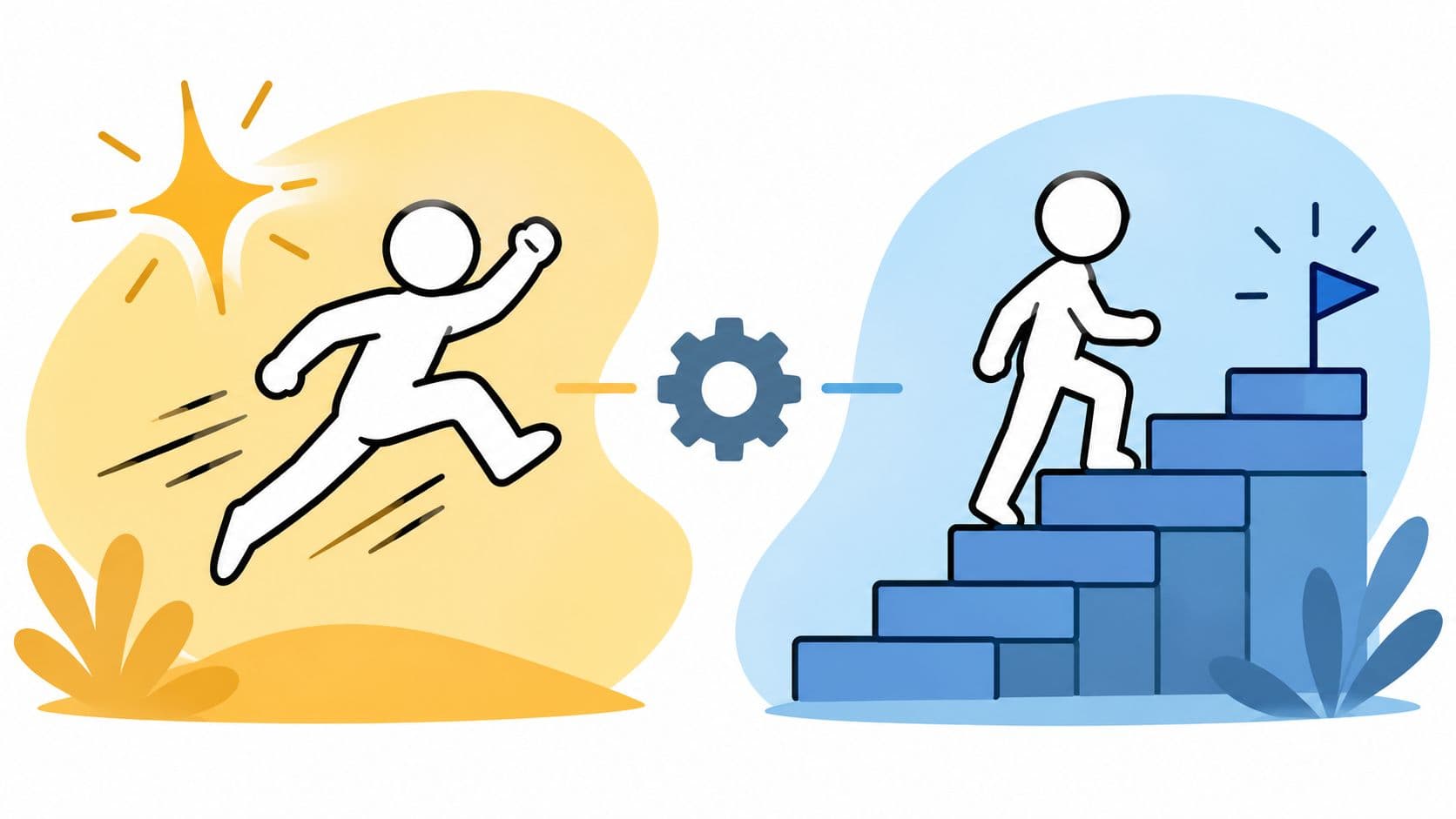
That failure isn't proof that you lack character. It means the hardest decision was left available at the worst possible moment. Motivation gets you to start. Discipline helps you continue. A well-designed system covers the gap when neither feels reliable.
Why You Keep Turning It Off
The usual productivity advice treats distraction as an information problem. You already know that scrolling interrupts work. You already know that games and social feeds can consume an evening. You may even have installed a blocker before. The issue is that the off switch remains close enough to reach while your impulse is active.
A 2015 laboratory study summarized by the World Economic Forum found that people called during a cognitive task made 28% more errors when they didn't answer. People who received a text but didn't look at their phones made 23% more errors, while participants with no incoming messages still made 7% more errors, likely because of fatigue. A later experiment with 22 participants across two five-hour work sessions found that phones within immediate reach were used almost twice as much, adding about 14 minutes per session, although moving the phone away shifted some activity to laptops.
The numbers matter less than the pattern. A small interruption can weaken the next decision, and a device that stays available keeps presenting new opportunities to abandon the task.

The weakness is badly timed
You might make a sensible decision at 8:00 in the morning, then reverse it at 11:00 at night when you're tired, bored, or avoiding a difficult task. Both decisions come from the same person, but they happen under different conditions.
That's why “just be disciplined” is weak advice. It asks you to perform your best self-control precisely when the reward from distraction is immediate and the reward from continuing is delayed. Your blocker may be doing its job technically, but if you can disable it in the same impulse, the system still leaves the decisive move to you.
Practical rule: Don't measure discipline by how strongly you feel about the plan before temptation appears. Measure it by what happens after the urge arrives.
The useful question isn't whether you're motivated enough. It's whether the productive choice remains easier than the impulsive one. If the answer is no, change the conditions before starting the session.
What Motivation and Discipline Actually Are
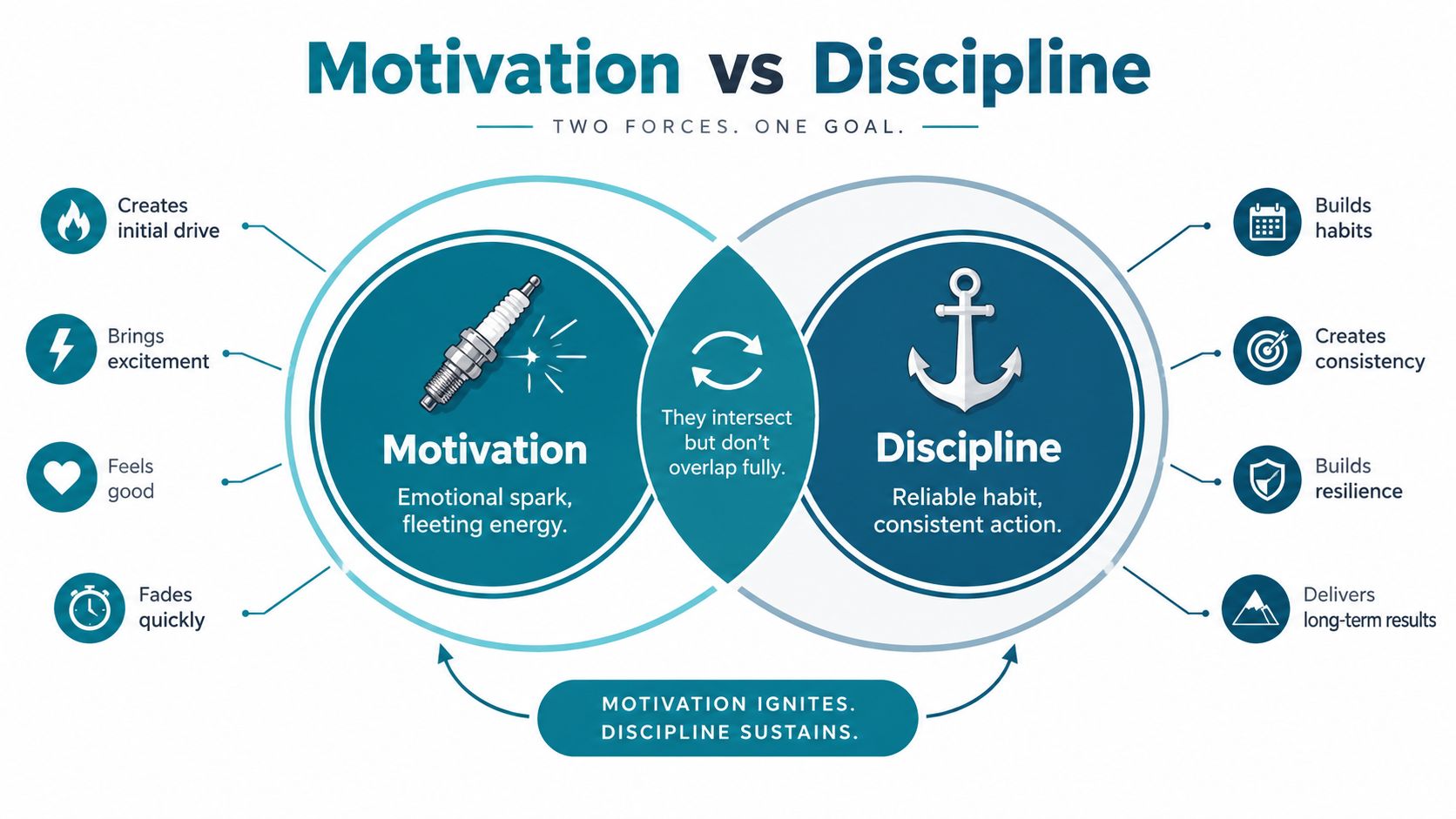
Motivation is initiation energy. It gives a task emotional weight, makes a new direction feel worthwhile, and helps you choose what to pursue. It's useful when you're picking a subject, starting a project, or deciding that your current routine has to change.
Discipline is repeated execution under less interesting conditions. It's the structure that carries out a decision after the initial excitement fades. Discipline doesn't require you to feel inspired every time. It requires a rule, a cue, and a response that you can repeat.
Implementation intentions make that distinction practical. They turn a vague goal into a context-triggered rule: if situation Y occurs, then I will do Z. In an adolescent exam-preparation study, a 30-minute mental-contrasting and implementation-intentions intervention led students to complete more than 60% more practice questions than a placebo control, according to the self-regulation research paper from the University of Konstanz. The planning step reduces negotiation when the moment arrives.
Why repetition changes the task
A neuroscience review describes how repeated rewarded behavior can shift control from the dorsomedial striatum toward the ventral and dorsolateral striatum. It also reports that inhibitory-control activity in the lateral prefrontal cortex and dorsal anterior cingulate cortex can move earlier as practice accumulates, as explained in this review of habit and self-control systems.
You don't need to memorize those brain regions to use the finding. The practical point is that durable discipline depends less on repeatedly wrestling with an urge and more on making the desired response predictable. A study block that always starts at the same time, with the same apps blocked, asks for fewer fresh decisions.
Motivation chooses the direction. Discipline establishes the route. Environment design keeps the route usable when your mood changes.
When to Rely on Motivation and When to Rely on Discipline
Use motivation when the main problem is starting something uncertain. You need enough interest to choose a subject, define a project, or take the first uncomfortable step. Motivation can help you compare options, imagine a meaningful result, and decide which effort deserves a place in your schedule.
Use discipline when the direction is already clear and the problem is continuing after novelty fades. A study block, deep-work session, sleep routine, or writing habit usually needs structure because the payoff comes later and interruption is immediately rewarding.
A simple diagnostic rule works well:
| User situation | Typical failure point | Better lever |
|---|---|---|
| Choosing a new goal | Too many possible directions | Motivation to select a meaningful target |
| Beginning an unfamiliar project | Uncertainty about the first action | Motivation plus a small starting rule |
| Repeating study or work | Boredom and easy interruptions | Discipline through a protected session |
| Maintaining a sleep routine | Negotiating with yourself late at night | Discipline through a recurring schedule |
| Exploring creative ideas | Stagnation or lack of curiosity | Motivation and flexible experimentation |
The distinction isn't about personality. A motivated person can still abandon a task when the conditions make distraction effortless. A disciplined person can still struggle to begin when the target is vague.
Use motivation to decide what deserves your effort. Use discipline to protect that effort after the feeling changes.
This also prevents a common mistake: using more inspiration to solve a continuation problem. Another video about productivity may make you feel ready again, but it doesn't change the off switch, the notification pattern, or the open feed waiting beside your work.
When you notice repeated abandonment, stop searching for a stronger emotional push. Define the trigger, define the response, and make the response easier to execute than the old habit.
Why Willpower Alone Keeps Failing
Willpower is weakest when the decision is immediate, private, and reversible. A reminder asks you to remember the right choice. An enforced constraint changes the available choices before the urge arrives.
A 2008 randomized field experiment published by the National Bureau of Economic Research tested an app-based self-control tool that reduced college students' phone use during class. The treatment was associated with better classroom focus, improved attendance, higher academic satisfaction, and higher semester grades, as reported in the published study PDF. The important mechanism was pre-commitment. Students made the decision before temptation rather than relying on resistance during class.
The same source describes a 2017 study of 262 workers that found a moderate relationship between smartphone addiction and self-reported productivity loss at work, including more hours lost to phone use. Repeated small lapses don't need to feel dramatic to damage a workday.
Soft reminders versus real friction
A reminder says, “You should stop.” A constraint says, “The next action has a cost.” That difference matters because an impulse usually seeks the fastest available reward.
A recent expert review on ADHD, youth, and digital media argues that effective limits work better when they create immediate, logical consequences instead of relying on reminders or abstract self-control. This doesn't mean every person needs the same level of restriction. It means optional tools are poorly matched to a failure mode built around quick, automatic bypasses.
The research on screen reduction also argues against simplistic promises. A 2025 randomized study of 111 university students found that reducing screen time to two hours per day or less improved well-being, depressive symptoms, sleep quality, and stress. Intervention participants reduced screen time by about 155 minutes per day, although not everyone reached the target, according to the study published in PMC. The same source discusses a 2025 exploratory study in which tracked-screen-time nudges didn't significantly reduce screen time, though sleep-delay frequency improved, and a systematic review of ADHD digital interventions found that overall effectiveness remained inconclusive because evidence quality was low.
The conclusion is narrow but useful. Gentle nudges may help some behaviors, but someone who already disables blockers at the moment of weakness needs more friction, not another notification.
Building a Discipline System That Holds
A usable discipline system removes decisions from the moments when you're least likely to make them well. Build it around the context in which distraction happens, not around an abstract promise to “use your phone less.”
Start with context-based blocking
Create separate groups for work, study, and sleep. A work list might contain social apps and entertainment. A study list might remove messaging and video platforms. A sleep list might focus on the apps that keep you awake after you've already decided to put the phone down.
The point is precision. Blocking everything all the time can create unnecessary resistance, while blocking nothing during the risky window leaves the old loop intact.
Schedule the decision in advance
Recurring sessions remove the daily question of whether you feel like starting. Android's Digital Wellbeing Focus mode supports scheduled blocking windows. Its documented flow is to choose the apps, select Set a schedule, and choose the days, start time, and end time through the Android scheduling guidance.
For stronger enforcement, Android's built-in app time limits let you set a unique 4-digit PIN for app limits. Google's instructions also say an app time limit can be set to zero to block access entirely, as described in the Android app-limit documentation. That changes the tool from a soft warning into a rule with an additional barrier.
TiedSiren takes a different approach within its listed Android feature set. You choose applications, commit to a duration, and run a session in Strict Mode. The session ends when its timer ends, the Android Settings screen is blocked while it runs, custom blocklists can be grouped by context, and sessions can recur daily or weekly. It's available for Android 8.0 and later.
Add feedback without turning it into entertainment
A visible focus timer shows how long remains in the current session. That feedback gives the task a defined boundary, which is easier to follow than an open-ended instruction to “work for a while.”
The system should also make impulsive bypass less convenient. It doesn't need to claim perfection. It needs to defeat the five-second undo, the one you perform without premeditation because the route is right there.
Google's Family Link guidance shows why timing details matter. App blocks may take about 5 minutes to apply or take effect when the device reconnects to the internet, and a child already using the app receives a 1 minute warning before the block takes effect, according to Google's Family Link instructions. That's a documented delay, not an instant lockout, so choose tools and schedules with their actual behavior in mind.
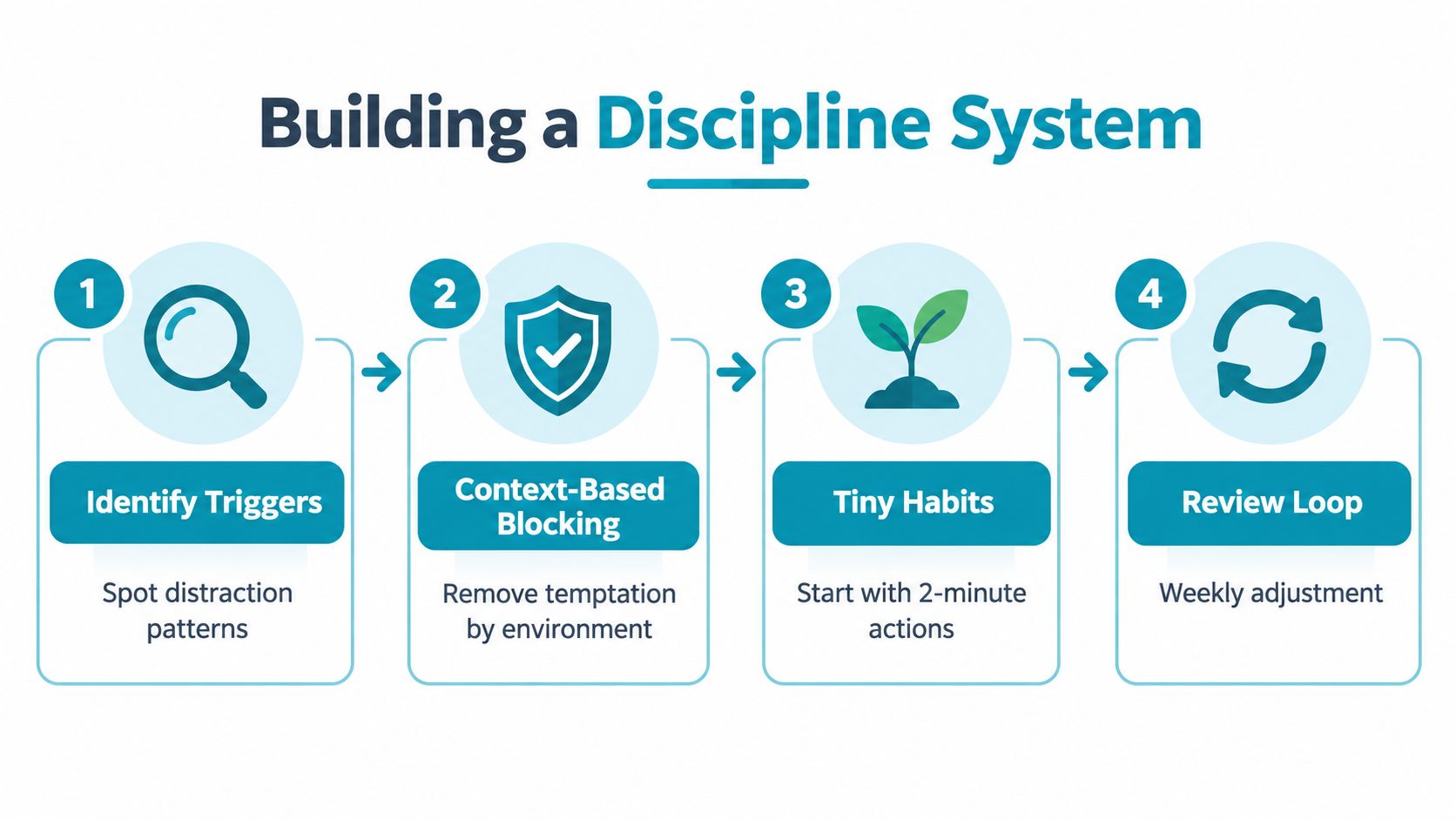
The system works when each part supports the next:
- Identify the trigger: Note which app, time, and context precede the slip.
- Choose the blocklist: Match blocked applications to work, study, or sleep.
- Set the recurrence: Remove the need to restart the decision every day.
- Review the friction: If you keep bypassing the system, raise the cost of the impulsive route.
The timer is not a moral test. It's a boundary you designed while thinking clearly.
How Different Users Apply This Differently
A student preparing for an exam doesn't need the same system as a developer protecting a coding block. The underlying issue may be similar, but the trigger and reward differ.
A student often loses momentum through small checks of social apps, messages, or short videos. Each check seems harmless, but it breaks the continuity needed for difficult material. The useful lever is a scheduled study session that blocks the distracting context before the student opens the book or practice set.
A knowledge worker or developer faces a different leak. The problem may be switching between documentation, chat, feeds, and unrelated tabs whenever a task becomes ambiguous. A recurring deep-work session creates a protected period in which the person can stay with the difficult part instead of rewarding every moment of uncertainty with a new input.
Someone dealing with compulsive scrolling or mobile gaming needs to group the high-reward apps together. Blocking only one visible trigger can leave the same impulse with another outlet. The blocklist should match the behavior loop, not merely the app that happened to be open during the last lost hour.
Adults with ADHD-like distraction patterns may find gentle prompts too easy to dismiss. The publisher's background and product context describe an approach built around committed sessions and added friction rather than reminders alone. That doesn't make every intervention effective for every person, and the broader ADHD evidence remains mixed. It does make the choice architecture more aligned with someone whose main problem is the immediate undo.
| User situation | Typical failure point | Better lever |
|---|---|---|
| Student preparing for exams | Interruptions during delayed-reward study | Scheduled blocking during study windows |
| Developer or knowledge worker | Context switching when work becomes difficult | Recurring deep-work sessions |
| Compulsive scrolling | Immediate access to several rewarding feeds | One context blocklist covering the trigger apps |
| Adult with ADHD-like distraction patterns | Optional reminders are easy to dismiss | A timed session with meaningful bypass friction |
| Mobile gamer | The rewarding app is available during work or sleep | A recurring block matched to the risky period |
Motivation can still start the process. It may help someone install a blocker, choose a study target, or commit to a new routine. But the system carries the routine after that initial feeling has done its job.
The Core Difference and How to Use It
Motivation and discipline solve different problems. Motivation chooses the target, clarifies why it matters, and prompts the first decision. Discipline repeats that decision after the novelty disappears.
Use environmental design when an impulse moves faster than deliberate reasoning. A useful system assigns each tool a job instead of expecting motivation or discipline to handle everything.
Motivation can start a routine, but it cannot reliably schedule every difficult session. Discipline can repeat a behavior, but it cannot repair a vague target or a poorly designed environment. Combining them works better: motivation sets direction, discipline maintains the action, and the environment reduces unnecessary choices.
Someone who has installed a blocker and disabled it during a difficult moment does not need more self-blame. They need the session configured before the urge arrives, the relevant apps grouped by context, a schedule that removes repeated negotiation, and enough friction to make an impulsive bypass harder.
Developers who need context-specific tools can review the developer information to understand how the product is positioned. The practical rule is simple: set the productive action as the default before motivation drops.
Discipline becomes more dependable when the environment carries part of the workload. Each protected session then requires fewer acts of willpower.
TiedSiren is a free Android app that lets you choose applications, set a committed duration, and run scheduled or recurring blocking sessions with a focus timer and added friction around the Android Settings route. Visit TiedSiren to set up one protected work, study, or sleep window before the next impulse arrives.