
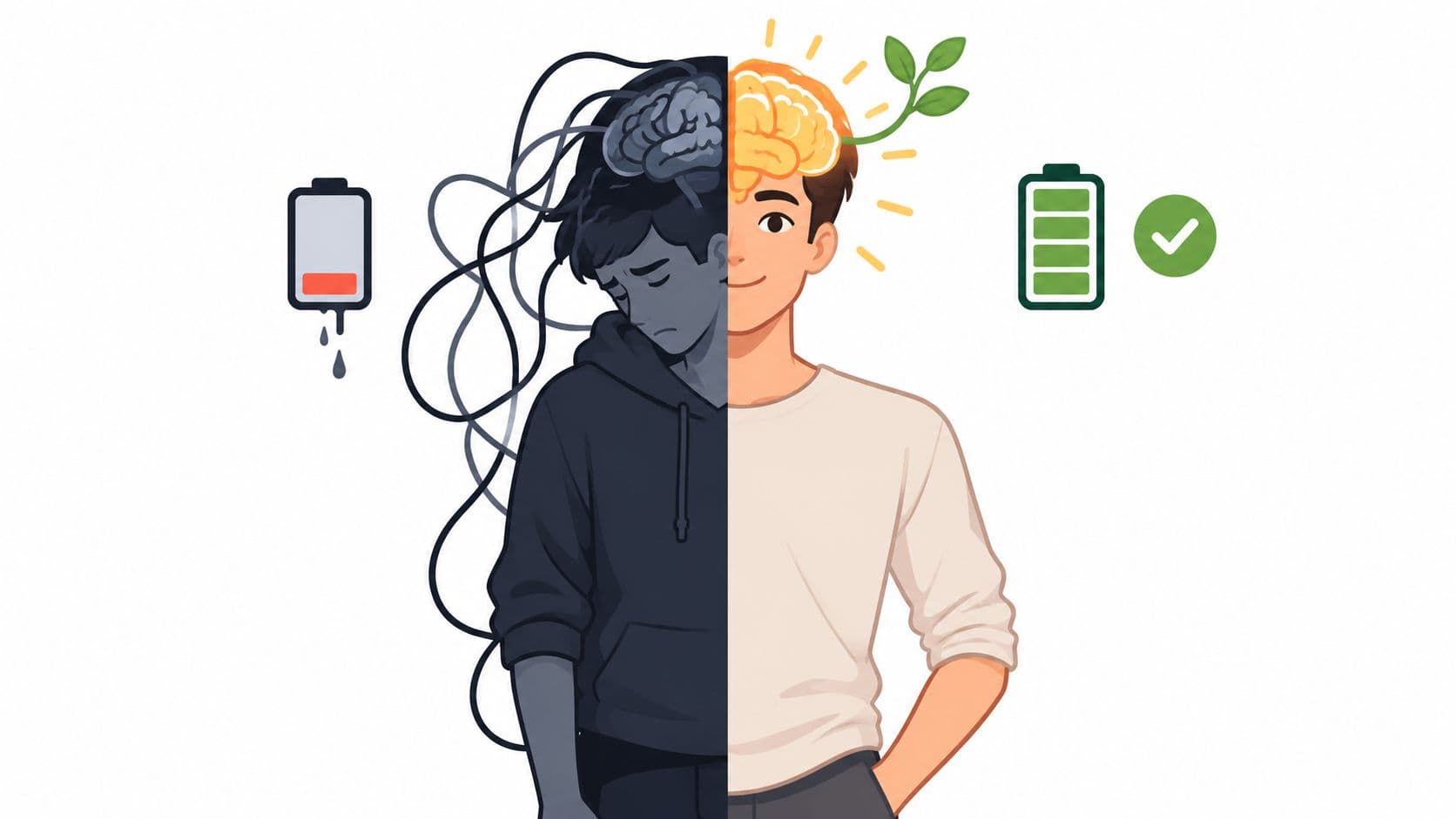
You're staring at the same screen you opened an hour ago. The document is still blank, the task is still waiting, and your phone keeps winning because opening one more app feels easier than starting the thing you care about.
Then you call yourself lazy. That label feels simple, but it usually explains very little. Low motivation can come from sleep loss, depression, ADHD-related executive-function difficulties, procrastination, or an environment that keeps interrupting your attention. The useful question isn't “What's wrong with my character?” It's “What is making action feel too costly right now?”
Understanding Why You Feel Stuck
People searching for “why am I so unmotivated” already know what they should do. They don't need another list of productivity slogans. They need to understand why the decision makes sense in theory but falls apart when the moment arrives.
You might stare at a blank document, scroll without enjoying the feed, or move between unfinished tasks because every starting point feels strangely heavy. That experience can look like laziness from the outside. Internally, it often feels more like a blocked pathway between intention and action.

Procrastination is a signal, not a verdict
Procrastination gives us one measurable window into this problem. A summary of productivity research places chronic procrastination at about 20% of adults globally, while college populations report much higher levels, with 80–95% of students procrastinating and up to 50% experiencing persistent or problematic procrastination. In workplace estimates, 88% of workers postpone at least one hour of work per day, while another estimate puts average daily losses at about 2 hours and 11 minutes, or roughly 55 days per year. These figures are summarized with source links in recent productivity statistics research.
Those numbers don't prove that every unmotivated person has the same cause. They do challenge the idea that repeated delay is a rare moral failure. People across countries and settings run into the same gap between knowing and doing.
Temporary depletion versus a persistent pattern
A bad night, a tedious assignment, or a stressful week can reduce your drive temporarily. Rest, a smaller task, or a change in context may be enough to restore movement.
A persistent pattern deserves closer attention. If you regularly struggle to begin ordinary tasks, lose hours to avoidance, or feel disconnected from activities that once mattered, stop treating the problem as something a harsher internal speech will solve.
Practical rule: Treat “I'm lazy” as an incomplete diagnosis. Ask whether you're tired, overwhelmed, under-stimulated, distracted, depressed, or facing a task with no immediate reward.
Curiosity is more useful than shame. Once you identify the friction, you can change the conditions around the task instead of demanding more effort from a system that's already overloaded.
The Biological Roots of Low Drive
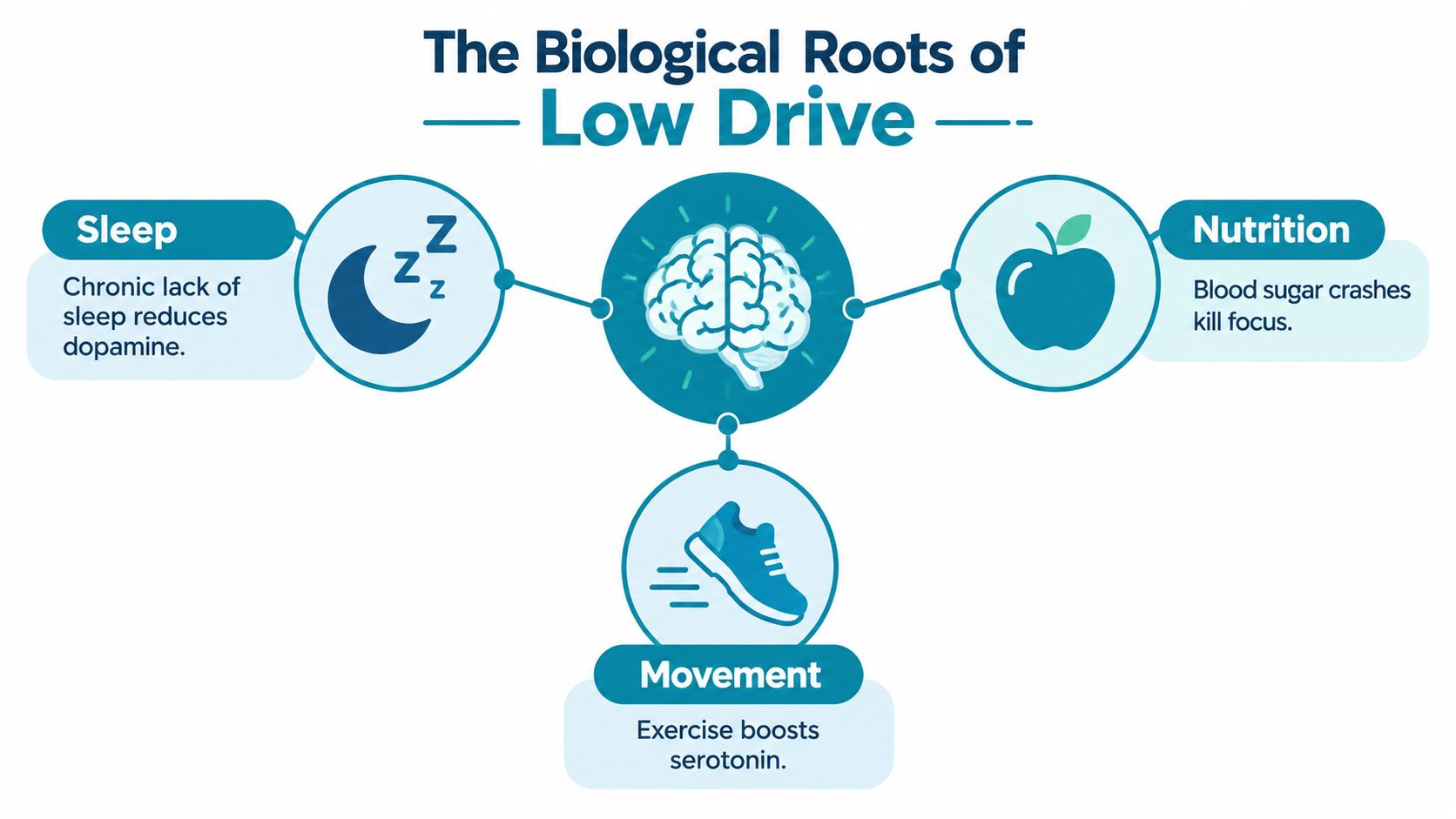
Motivation depends on physical conditions. Your brain has to evaluate an action as worth its effort, and sleep loss can change that calculation before you've made any conscious decision.
In a controlled sleep-restriction study, five days of chronic restriction reduced subjective motivation from 2.8 ± 0.6 to 2.2 ± 0.5, while sleepiness rose from 3.2 ± 1.2 to 5.1 ± 1.8. One recovery night didn't restore motivation. The findings are reported in the controlled study on sleep restriction and motivation.
Sleep changes the price of effort
Sleep deprivation doesn't only make you feel tired. Another finding from the same research area showed that sleep restriction selectively reduced willingness to exert cognitive effort, while physical motivation was spared. That distinction matters. You may still be willing to take a walk, cook something simple, or complete an automatic routine, yet feel unable to write, plan, study, or make a difficult decision.
Your brain may be pricing mental work as too expensive. The task hasn't necessarily become harder, but your available capacity has changed. Telling yourself to “push through” ignores the biological calculation happening underneath the resistance.
Start with the unglamorous basics. Protect a consistent sleep window, eat regularly enough to avoid running on fumes, and use movement to interrupt long periods of inactivity. These steps won't resolve every cause of low motivation, but they remove common obstacles before you interpret the problem as a personality defect.
ADHD can alter reward timing
ADHD adds another biological and neurological pathway. Motivation may depend heavily on how immediate, stimulating, or rewarding a task feels. A long-term benefit can be intellectually important and still fail to create enough activation to begin.
That doesn't mean every unmotivated person has ADHD. It means inconsistent drive, especially when paired with chronic disorganization, impulsive distraction, and difficulty starting routine tasks, deserves a more serious interpretation than “I need more discipline.”
Psychological Factors and ADHD
The hardest version of this problem is knowing exactly what matters and still being unable to initiate it. You understand the deadline. You can explain the consequences. You may even have a carefully written plan. Then a small immediate reward, such as a feed, video, or game, wins again.
ADHD can make that conflict especially sharp. Recent U.S. estimates place current adult ADHD diagnosis at about 15.5 million adults. More than half of adults with ADHD were diagnosed in adulthood, and about one-third aren't receiving treatment, according to the ADHD and motivation overview.
Delay aversion makes distant rewards weak
A 2022 review found a medium-effect-size preference for smaller immediate rewards over larger delayed rewards among people with ADHD. This pattern is often called delay aversion. It doesn't mean someone with ADHD doesn't care about future outcomes. It means the future outcome may not generate enough motivational force in the present moment.
That explains why a person can want a degree, a healthier body, or a better career and still avoid the next study session, workout, or application. The goal is meaningful, but the reward is delayed. The phone offers a reward now.
Research also supports a distinction between attention and impulse-related pathways. Inattention is associated with executive-function difficulties, while reward and punishment sensitivity tracks more closely with impulsivity and hyperactivity. Motivation and control interact, so the visible result may be inconsistent follow-through rather than a lack of ambition.
Depression can remove the reason to start
Depression changes more than energy. It can reduce pleasure, hope, concentration, and the sense that effort will lead anywhere. A review cited in recent mental-health reporting on motivation and ADHD states that reduced motivation appears in 70–90% of adults during a major depressive episode.
That's why a productivity tool shouldn't become a substitute for assessment. If tasks feel pointless, you've lost interest in nearly everything, or ordinary responsibilities are becoming difficult to maintain, consider whether low motivation is a symptom rather than the central problem.
Recent ADHD research also links inattention-related procrastination with delay sensitivity, low perceived task value, and flexible goal adjustment, as described in research on ADHD symptoms, procrastination, and task value. The practical conclusion is straightforward: make the next action concrete, immediate, and visibly connected to something you value. Don't rely on the distant goal to carry the whole task.
Digital Fatigue and the Modern Environment
Sometimes you aren't lacking drive. You're overloaded by an environment that repeatedly spends your attention before you can use it.
A young person can finish work or study, reach for a phone, and spend hours switching between social platforms without feeling restored. Each interaction is small, but the constant decisions, alerts, feeds, and unfinished loops leave little attention for slow work. The person then concludes, “I can't focus,” when a more accurate description is, “My attention has been fragmented all day.”
A 2025 social-media behavior report found that young people were spending over 4 hours a day on social platforms, with many describing their screen time as addictive. A separate 2026 survey reported that 64.4% of respondents felt tired and exhausted after long online sessions, while 61% wanted to spend less time online but couldn't. The figures and their context appear in the social-media behavior report.
Fatigue is different from laziness
Digital fatigue can resemble low motivation because it leaves you capable of easy consumption but resistant to demanding output. You can watch another video, but opening a difficult document feels impossible. That contrast creates shame, even though the two activities place very different demands on attention.
The environment also keeps presenting immediate alternatives. A notification interrupts a thought. A feed removes the need to choose what comes next. A message creates a new obligation before the previous one is finished. Your brain keeps responding, but response isn't the same as progress.
Your environment can make distraction easier to begin than the work you say matters.
A useful fix is to change access during the hours when your attention matters most. Put the phone outside the room, remove visual triggers, and block the applications that reliably pull you away. The focus and blocking features show one way to structure that boundary on Android.
Don't expect a motivational speech to outperform an always-available feed. If the distraction remains one tap away, your tired future self has to negotiate with it repeatedly. Reduce the number of negotiations instead.
Structural Fixes vs Willpower
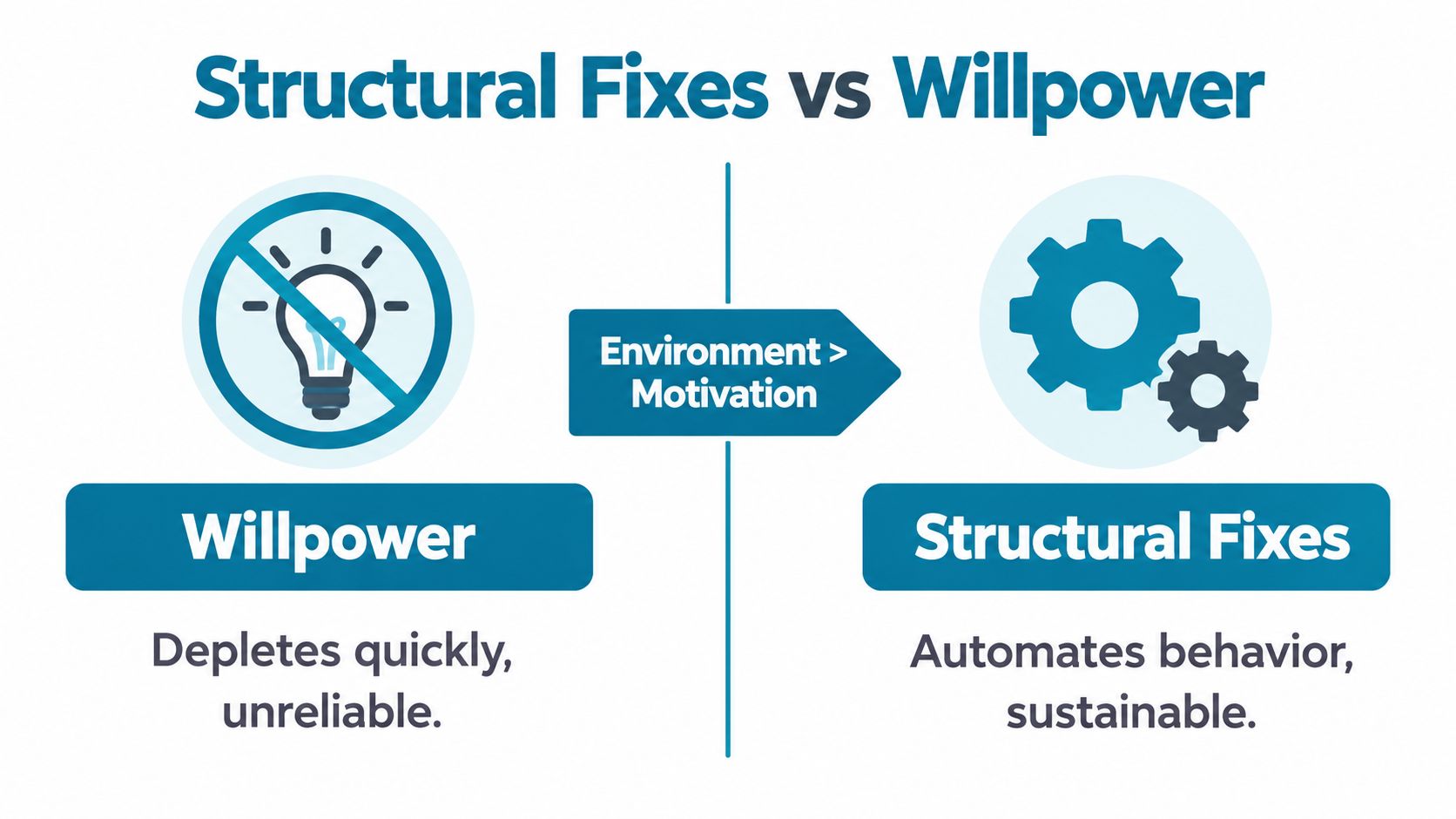
Willpower is useful for choosing a direction. It's unreliable as the only enforcement mechanism.
You can plan a study block in the morning and still cancel it at night. You can promise yourself that you'll check one message and then spend the next hour scrolling. The failure often happens because the decision is being renegotiated at the exact moment your attention is weakest.
Internal control has a real limit
Planning, intention setting, and routines still matter. They help you decide what deserves time and make the first action clearer. They don't remove the tempting alternative from the room.
External structure handles a different part of the problem. It changes what is available, how quickly you can access it, and how much effort it takes to reverse a decision. That matters for the impulsive bypass, the five-second decision to disable a blocker because discomfort has arrived.
A systematic review of 28 digital self-control interventions found that blocking tools can restrict access entirely, limit access duration, or add friction before access resumes. The systematic review of digital self-control interventions reported that a 30-digit input before opening an app was more effective than a 10-digit input or a simple warning prompt.
The lesson isn't that every barrier must be extreme. It's that friction gives the deliberate part of your mind time to catch up with the impulsive part.
What a stronger blocker should change
A blocker is useful when it supports a decision you made before the urge arrived. A free Android app can let you choose applications, commit to a duration, and keep the session running until its timer ends. Some tools also let you group blocklists by context, schedule recurring sessions, and show the remaining focus time.
One option built around this failure mode is available through the Android blocker download page. It uses Strict Mode for committed sessions and blocks the Android Settings screen while a session runs, raising the effort required to undo the decision. That's friction, not an absolute guarantee, and it's aimed at defeating the impulsive bypass rather than a determined technical attempt.
The trade-off is clear. A softer reminder gives you flexibility but leaves the decision in your hands. A stricter session reduces your ability to renegotiate while it runs. Choose the level that matches the behavior you're trying to change.
How to Build Focus-Friendly Routines
Don't begin by blocking distractions after you've already opened them. Decide while calm, before the urge has a voice.
Start with a narrow window. Choose one context, such as study, writing, sleep, or morning work. Select the applications that usually pull you away, set the duration you can commit to, and begin the session before opening the first distracting app.
Build the routine before motivation arrives
Use a simple sequence:
- Choose the context: Create a blocklist for work, study, or sleep instead of treating every situation as identical.
- Set the commitment: Pick the duration in advance. Don't wait until you feel distracted to decide how long you'll focus.
- Start the session: Begin before the task, not after opening the feed or game.
- Use Strict Mode: Let the timer determine when the session ends. A running session ends when its timer ends, and nothing else ends it.
- Watch the remaining time: Use the focus timer as a visible boundary. You only need to handle the current session, not solve your entire life.
The Settings block matters because Android uses Settings for important app-level controls. Google's Android 8.0 documentation on background execution limits explains that users can enforce app restrictions through system Settings, even for apps targeting an older API level. Google's Android Help guidance on parental controls and app limits likewise directs users to Settings to change app access and time limits.
Blocking that route increases the effort required for an impulsive undo. You're buying time, not claiming permanent control.
After the first session feels manageable, schedule recurring windows. Daily or weekly recurrence removes one decision from the routine and helps protect the same period without requiring you to remember to start it every time.
The video below shows the kind of session-based approach that works best when you need a clear start and end point.
Keep the first routine boring. Put the phone away, open the exact document or textbook you named beforehand, and begin with a visible action such as writing one sentence, solving one problem, or reading one page. Structure can get you into motion, but the first step still needs to be small enough to start.
When to Seek Professional Help
A blocker can reduce environmental friction. It can't diagnose depression, ADHD, sleep disorders, or another health problem.
Professional support becomes more important when low motivation is persistent, affects work or daily responsibilities, or comes with hopelessness, major changes in sleep or appetite, loss of interest, or difficulty functioning. A pattern that keeps returning despite better sleep, reduced digital overload, and sensible structure deserves more than another productivity experiment.
Use this decision rule:
- Try environmental changes first when the problem appears mainly around specific apps, tasks, or times of day.
- Look for a broader cause when the same loss of drive affects work, relationships, hygiene, rest, and activities you normally enjoy.
- Seek clinical support when hopelessness, severe distress, or impaired daily functioning is present. Contact a qualified clinician or mental-health professional rather than trying to solve the issue through willpower alone.
ADHD may require assessment and treatment. Depression may require care that no app can provide. Seeking help isn't an admission of weakness. It's a more accurate response to a problem that may involve your health, not your character.
If you're unsure where to begin, use the contact page to ask about the practical side of building stronger digital boundaries, while treating persistent mental-health symptoms as a reason to speak with an appropriate professional.
Unmotivation is often systemic. Sleep, reward timing, executive control, emotional health, and digital access can all shape whether starting feels possible. Fix the part you can see, and get help with the part you can't.
TiedSiren is a free Android app that lets you choose apps, commit to a session duration, use Strict Mode, and increase friction by blocking Android Settings while the session runs. If the off switch keeps winning at the moment of weakness, visit TiedSiren and set up a focus window before the next urge arrives.