
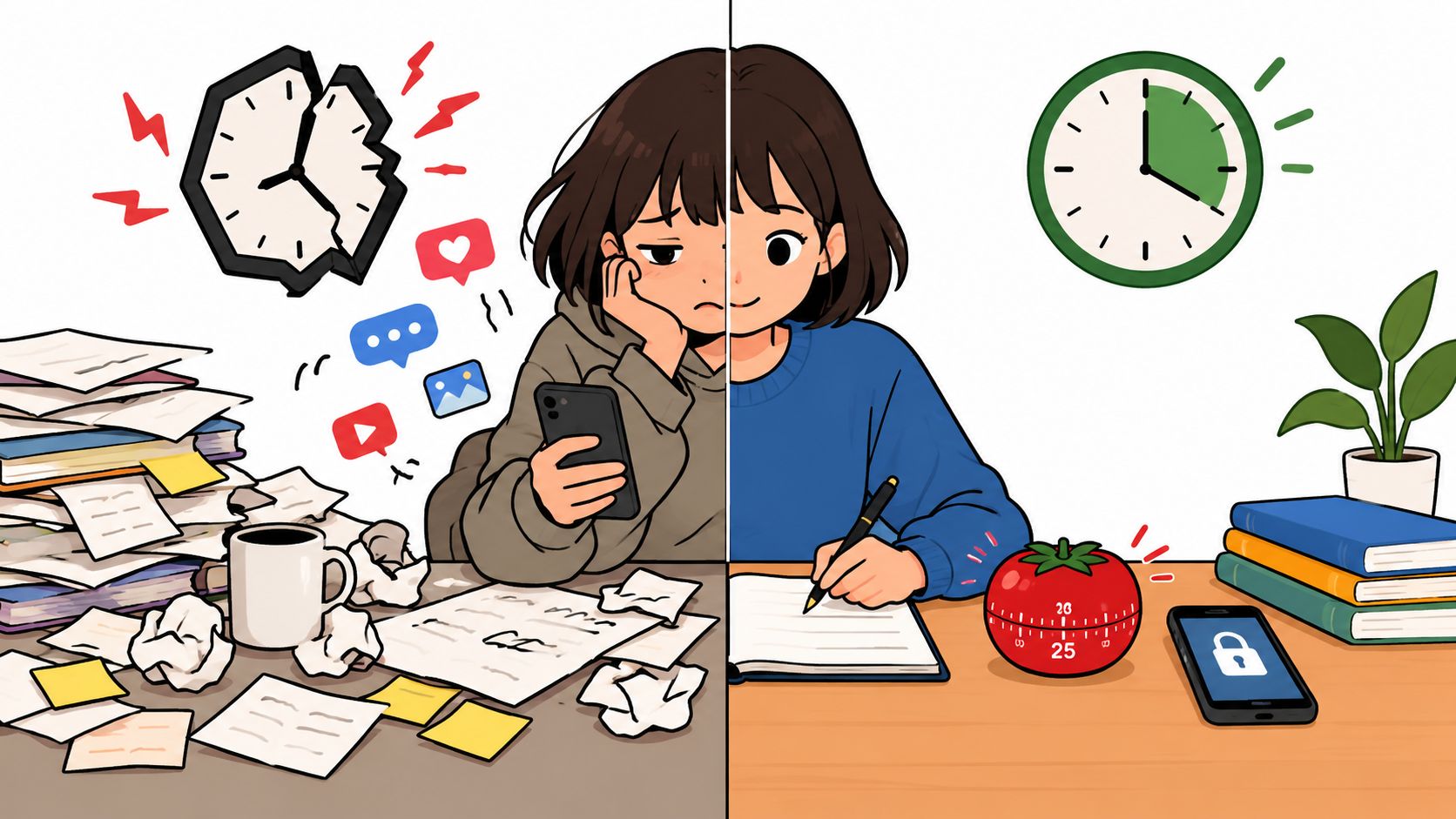
The popular advice about time management procrastination is usually a better planner, a cleaner morning routine, and more discipline. You already know the list: Pomodoro intervals, priority matrices, calendar blocks, productivity apps. You may even have tried most of them, then opened YouTube or Reddit the moment the work became uncomfortable.
That failure doesn't prove you lack information. It shows that your system leaves the critical decision exposed. At the moment you need to start, the distracting app is still available, the off switch is still nearby, and your tired brain gets to renegotiate a commitment made earlier.
Academic procrastination is pervasive in higher education. A synthesis by Steel estimated that it affected roughly 80% to 95% of college students, while earlier studies placed the share at 30% to 50%, and later international studies cited in reviews continued to report rates around 50% to 70% among university students. The same review links procrastination strongly with poor organization of time and effort, which means the practical problem is not just knowing what matters. It's converting intention into scheduled action. The higher-education review gives that pattern useful context.
The fix is structural, not informational. You need commitment architecture that removes choice when you're most likely to make the wrong choice, then combines time boxes, habits, and deliberate friction.
You Know What to Do, and That Is the Problem
You already know how procrastination advice works. Choose the priority, break it down, schedule it, silence notifications, and start before motivation arrives.
Then the scheduled moment appears, the report feels tedious or unclear, and your phone wins.
That outcome does not show a knowledge gap. It shows a commitment architecture failure. The plan describes the intended action, while every easier alternative remains available at the point where discomfort rises. The bottleneck is often the off switch sitting one tap away.
The exposed starting moment
Productivity advice often treats motivation as the missing part. That shifts responsibility onto the individual: try harder, care more, and become someone who follows through. It also ignores the trade-off. Willpower is taxed by decisions, interruptions, fatigue, and emotional discomfort, so asking for another difficult choice at the starting moment is poor system design.
Practical rule: If your distraction has an immediate off switch, expect to use it when the task starts feeling costly.
A 2025 higher-education study found that inadequate planning, poor monitoring, irresponsibility, emotional exhaustion, and neuroticism explained 61% of the variance in procrastination. The finding does not mean everyone avoids work for the same reason. It does show why a calendar can miss the emotional and self-regulation factors behind avoidance. The study on procrastination predictors makes that limitation clear.
Planning still has a job. It identifies the work and gives it a place. It operates before the pressure point, though, and cannot by itself control what happens there.
A reminder can appear and be dismissed. A timer can run and be ignored. A task can sit on the calendar while the feed remains easier to open. The practical question is therefore specific: which decision remains available when you are tired, bored, or anxious?
Usually, it is whether to start, whether to continue, and whether to disable the system. Close those decisions before the difficult moment, and time management becomes less dependent on willpower.
Why Planning Alone Does Not Move the Needle
A to-do list turns a wish into an intention. It does not tell your future, tired self what to do when the task becomes uncomfortable and the off switch is one tap away.
“Work on the report tomorrow” sounds responsible because it names the task and assigns it a place. It still leaves the execution unresolved. Which document will you open? What is the first action? What cue starts the session? Where will Slack, email, and the phone go? What happens when the work feels harder than expected?
Intention needs a trigger
Implementation intentions close that gap by connecting an action to a specific situation:
If X happens, then I will do Y.
“I'll study tomorrow” is a plan. “If I sit at my desk after coffee, I'll open the assignment and answer the first question” is an instruction. It removes several choices from the moment when avoidance is most likely.
Procrastination often begins after planning ends. You can feel organized while arranging the task, then meet it later without a usable starting command. The room, inbox, phone, and browser offer competing cues. The easiest cue usually wins, especially when distraction can be stopped or started immediately.
A 2024 ACT-based study found that changes in psychological flexibility and time and effort management both affected procrastination. The finding supports an approach that addresses emotional responses and execution, rather than treating planning as a complete solution. The ACT-based study connects follow-through with more than calendar quality.
The plan can become the avoidance
Planning fails when it becomes a substitute for work. You adjust categories, rename projects, refine the calendar, and search for another system. The order feels productive because it is visible. It still may not produce a finished paragraph, solved problem, or submitted assignment.
The harder problem is self-regulation. One intervention study found that a structured time-management program reduced the Academic Procrastination Scale score from 54.11 ± 13.10 before training to 44.88 ± 10.40 afterward, with the decline statistically significant at p < 0.001. Another study found that time-management-related variables explained 61% of the variance in procrastination. The intervention research supports training in planning and monitoring, while leaving no reason to treat planning as the whole fix.
A workable system therefore settles the commitment before discomfort arrives. Decide the task, the start cue, the available distractions, and the stopping point in advance. The goal is not better intentions. It is fewer decisions left open at the moment of weakness.
Time Boxing and the Pomodoro Technique That Actually Holds
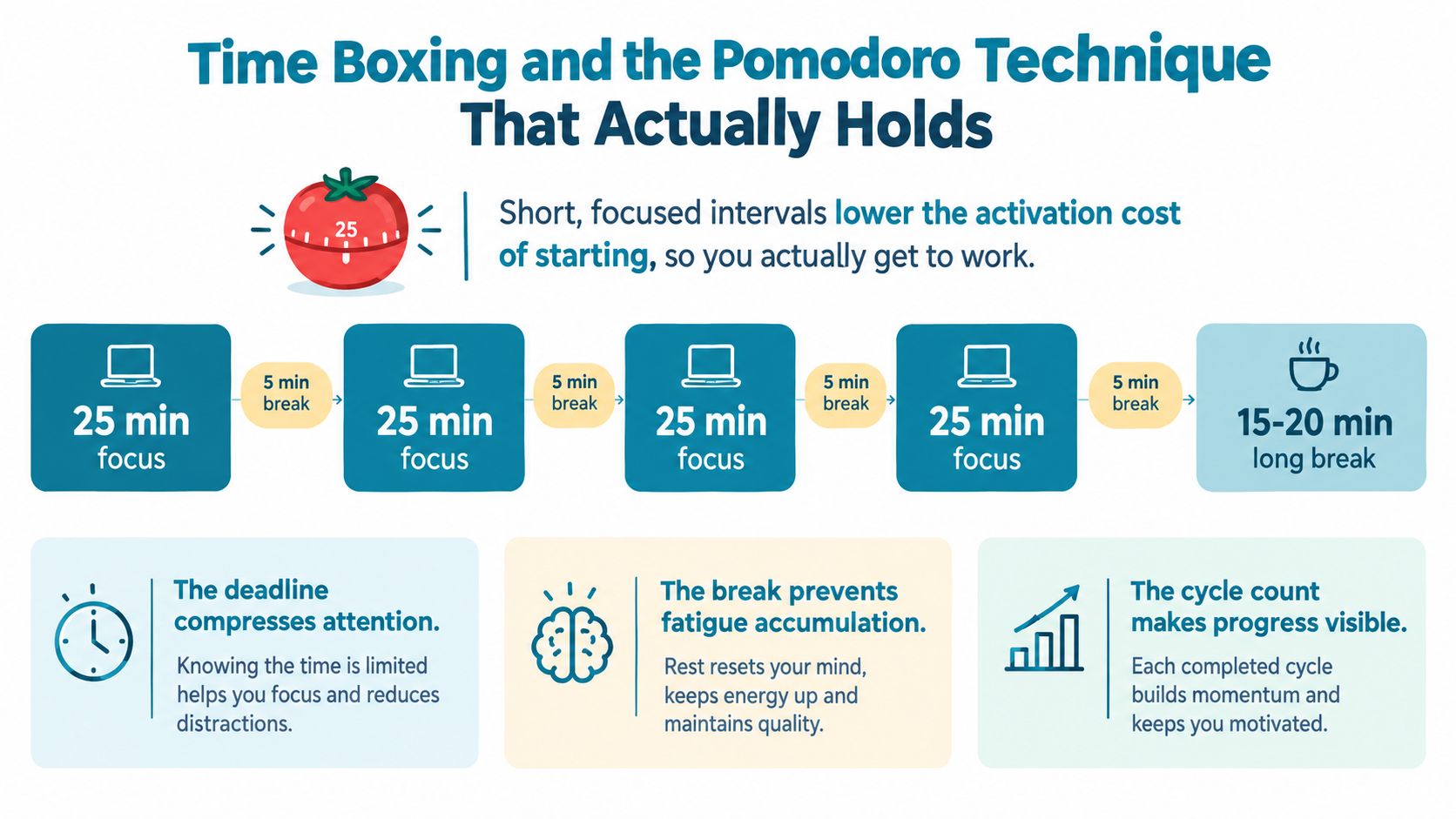
Pomodoro works because it makes the start smaller and the boundary clearer. The conventional structure is straightforward:
- Work for 25 minutes on one defined task.
- Take a 5-minute break.
- Repeat the cycle.
- After 4 cycles, take a longer break of 15 to 20 minutes.
The short interval lowers the perceived activation cost. “Write the report” feels heavy. “Open the document and work until the timer ends” is smaller. A defined endpoint also helps people who avoid starting because they fear getting trapped in an exhausting, undefined work session.
Use the ratio as a boundary
The break isn't a reward you earn by exhausting yourself. It prevents fatigue from degrading the next cycle. Keep it short, stand up, drink water, or look away from the screen. Don't turn a five-minute pause into an invitation to open an infinite feed.
For a 90-minute writing block, use three Pomodoros rather than pretending the whole period is one uninterrupted push:
- 25 minutes: outline the argument.
- 5 minutes: stand up and reset.
- 25 minutes: draft the first section.
- 5 minutes: note the next paragraph and clear the desk.
- 25 minutes: revise and finish the block.
- 15 to 20 minutes: take a real longer break, then stop or schedule the next block.
The hard stop matters. Time boxing should protect both starting and stopping. If you regularly overrun every block, the method becomes another source of avoidance because beginning appears to threaten the rest of your day.
A timer isn't enforcement
A normal timer can be dismissed. That doesn't make Pomodoro useless, but it means the timer only provides information. If the phone remains full of distracting apps, the timer may become a prompt to switch tasks rather than a boundary around one task.
You can add enforcement by blocking selected apps for the interval. TiedSiren's feature overview describes sessions that run for a committed duration, custom blocklists grouped by context, recurring schedules, and a focus timer showing the remaining time. It supports Android 8.0 and later, as documented by Android's Oreo changes.
The clock isn't the main value. The pre-commitment is. You decide once, while calm, what happens during the next 25 minutes. You don't ask the tempted version of yourself to approve the decision again.
Even that structure needs a trigger. Without a reliable cue, the block remains something you intend to begin later.
Habit Design That Removes the Daily Decision
Motivation is a trailing indicator of action. It often appears after you begin, not before.
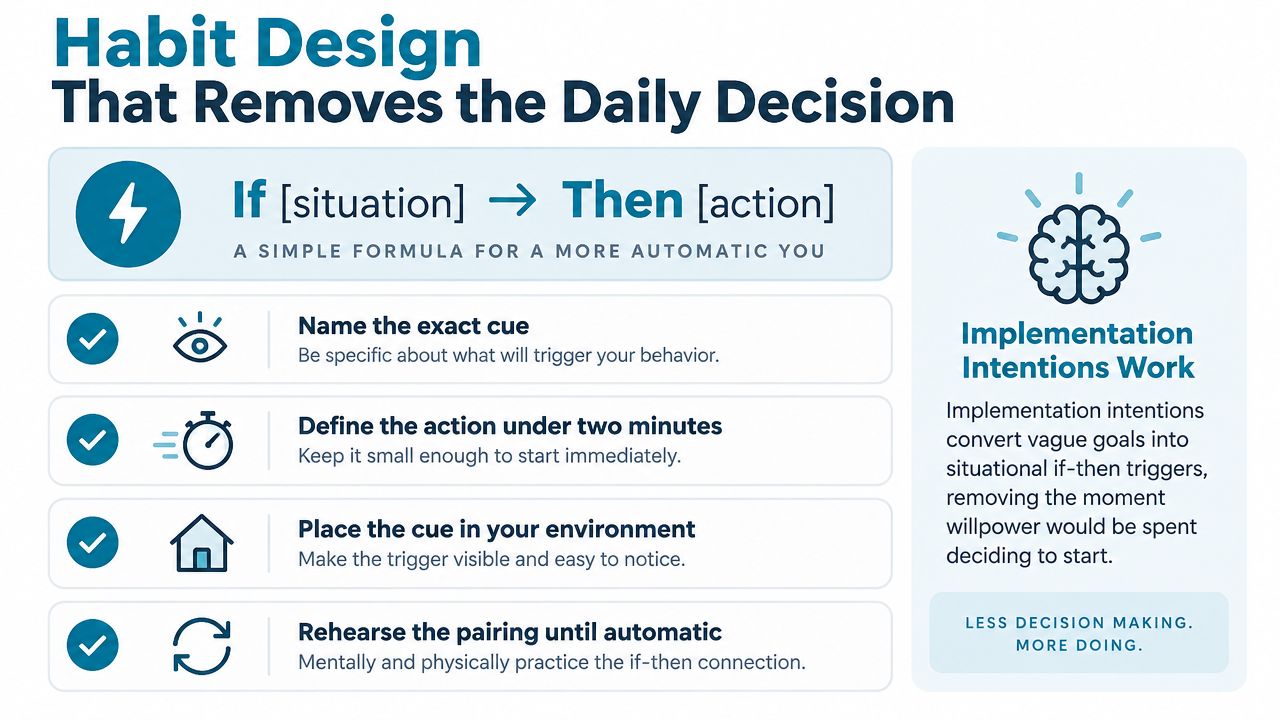
Implementation intentions solve the daily negotiation with a precise pairing:
When X happens, I will do Y.
The cue must be observable and the action must be small enough to start immediately. “When I feel motivated, I'll study” isn't a cue. “When I sit at my desk after coffee, I'll open the first task in my queue” is.
Build the pairing around real triggers
Use situations that already happen rather than inventing an ideal routine.
- After coffee: open the document or assignment already selected for the session.
- When the phone urge appears: write the distracting thought on a notepad, then return to the timer.
- When a work block ends: take a real walk for ten minutes before touching any app.
- When you close the laptop: write the first action for the next session.
The second example matters because distractions often arrive with useful-looking content. Writing the thought down preserves it without allowing it to take over the session. You don't need to trust your memory, and you don't need to obey every impulse immediately.
Stack the habit onto a fixed cue
Habit stacking means attaching the new behavior to something stable. Coffee, sitting at the desk, opening the laptop, or finishing a meeting can all serve as anchors. The anchor doesn't need to be impressive. It needs to occur consistently enough that the sequence becomes familiar.
Keep the first action under two minutes when possible. Open the document. Put the phone in its place. Start the scheduled timer. A tiny entry step reduces the amount of emotional resistance you need to overcome before the actual work begins.
Scheduled triggers outperform motivation-based triggers because they don't require you to evaluate your mood first. If you wait to feel ready, your brain gets a chance to present an alternative. If the cue starts the sequence, there is less room to debate.
The purpose of a habit isn't to remove freedom. It's to stop spending freedom on the same decision every morning.
Habit design narrows the negotiation window. It doesn't remove access to every distraction, and it doesn't address every form of emotional exhaustion or attention difficulty. For some people, particularly those dealing with ADHD-like patterns of distractibility, complex or monotonous tasks, and unreliable task initiation, external structure needs to carry more weight than internal intention. Recent work on adults with ADHD describes those execution difficulties.
That is where enforcement enters.
Reminders vs Enforcement, and Why Friction Wins
Reminder apps and enforcement apps solve different problems.
A reminder says, “You planned to work.” An enforcement tool changes what you can access during the work window. One asks you to make a good decision at the moment of temptation. The other moves the decision earlier, when you're still willing to commit.
| Dimension | Reminders | Enforcement |
|---|---|---|
| Decision point | The user decides when the notification appears | The user decides before the session begins |
| Dependence on willpower | High, because the user can dismiss or postpone the prompt | Lower, because selected access is restricted during the window |
| Failure mode | The reminder becomes another notification to clear | Excessive friction creates resentment if the session is poorly sized |
| Best use | Cues, check-ins, and habit formation | Protecting a defined period from impulsive switching |
Friction must be proportionate
Friction works best as a cooldown or a defined lock, not as a permanent cage. A short, deliberate barrier can defeat the impulsive bypass, the one completed in five seconds without premeditation. An overbuilt system that traps you during a legitimate urgent need will eventually feel hostile, and hostile tools get abandoned.
The distinction is important. Blocking isn't a substitute for choosing a sensible task, setting a realistic duration, or dealing with emotional avoidance. It prevents the easiest escape route while the commitment is active.
Android provides several control surfaces for app access. Google documents app restrictions through Settings paths such as Parental controls, App limits, and app-specific permissions in its Android help documentation. On managed devices, Android Enterprise can suspend selected packages so they appear grayed out and show a system dialog when opened, as described in Android's device-policy documentation.
TiedSiren fits the enforcement philosophy as a free Android app blocker. Its Strict Mode runs a session for the duration you commit to, blocks the Android Settings screen while the session runs, supports custom blocklists and recurring sessions, and shows the remaining time. It creates friction rather than claiming an absolute barrier, which is the honest standard for this category.
The right question isn't whether a blocker looks strict in its settings. Ask whether it makes the impulsive off switch inconvenient enough to survive the moment that usually breaks your plan. For technical implementation context, Android developers can review the TiedSiren developer information.
Putting Structure, Habit, and Friction Together
The three layers work in sequence.
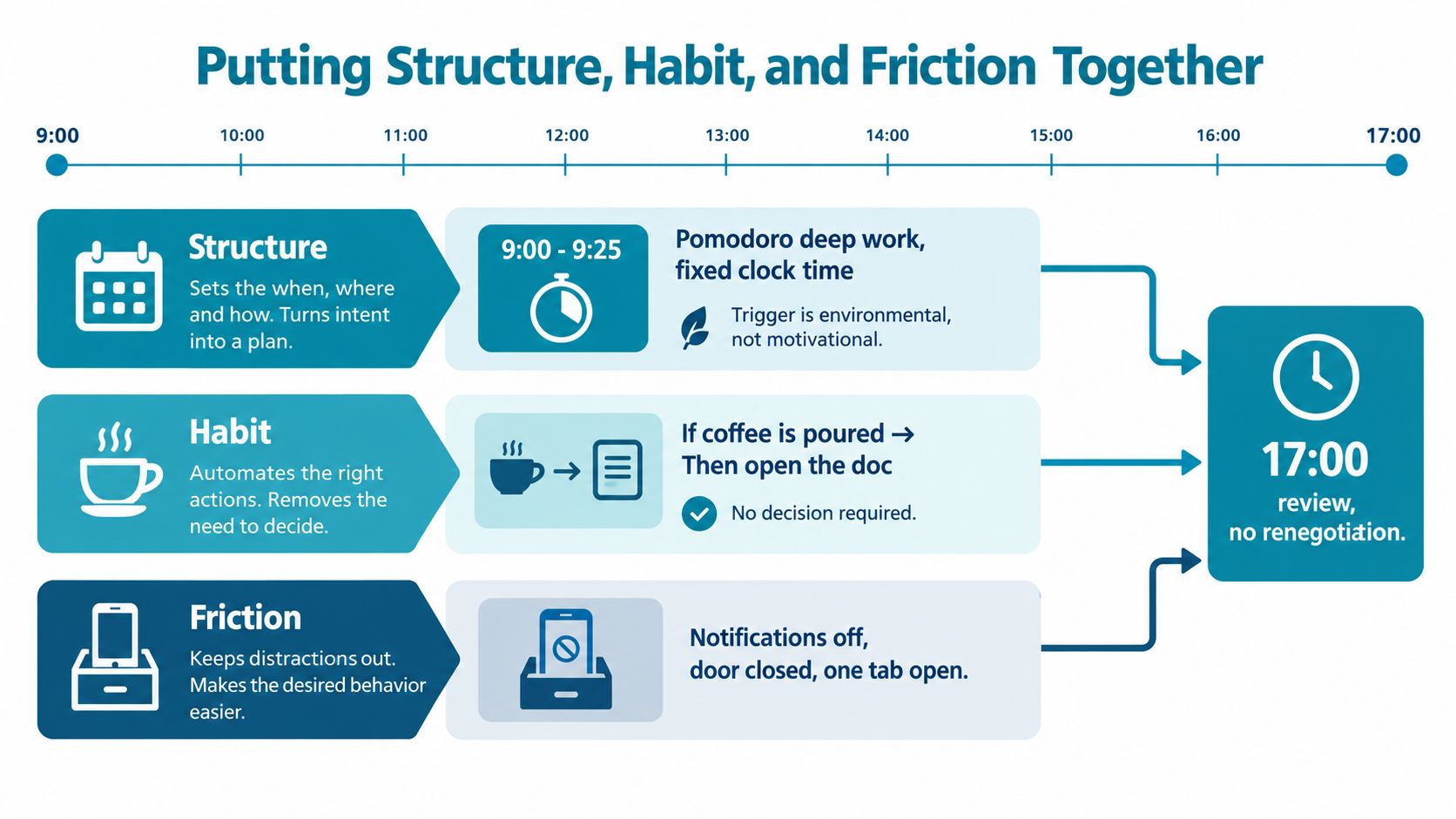
Structure decides when the work happens. Habit connects that time to a cue. Friction protects the commitment after the urge appears. Remove any layer and the system becomes easier to negotiate with.
A knowledge-work schedule
Use a fixed clock time rather than waiting for motivation:
- 09:00: start a 25-minute writing or coding block.
- 09:25: take a short break, refill water, and avoid opening a feed.
- 09:30: begin the next work cycle with the distracting apps blocked.
- 10:00: take the longer break and leave the desk.
- 10:20: review what remains, then schedule the next block.
The habit cue can be, “When coffee is poured, I open the document.” The friction layer keeps the phone from offering an effortless escape while the session is active. The endpoint preserves autonomy because the commitment has a defined finish.
A creative-work schedule
Creative work often needs a longer runway, but it still benefits from visible boundaries:
- 09:00: choose one output, such as a scene, concept, or draft section.
- 09:05: start the first focus interval and keep only the required material available.
- 09:30: take the short break, write down any competing idea, and return.
- 09:35: continue for two more cycles.
- 11:00: stop, record the next starting action, and take a substantial break.
The sequence matters. Don't begin by configuring friction around an undefined block. Choose the work first, attach it to a cue, then restrict the apps that reliably interrupt it. If you skip structure, the blocker protects an aimless period. If you skip habit, you must remember to start. If you skip friction, the first uncomfortable minute can reopen the entire decision.
A recurring schedule can remove the need to activate the system manually. Google Families documentation describes app limits that can be scheduled, with blocked apps marked as blocked and toggled back to allowed, which reflects the basic mechanics of recurring time-based limits. See Google's app-limit guidance for the platform-level example.
The practical setup is simple enough to reuse. Set the time, name the cue, choose the blocklist, and let the session end on its own.
You can download TiedSiren if you want to test this structure on Android.
The One Lever That Changes Everything
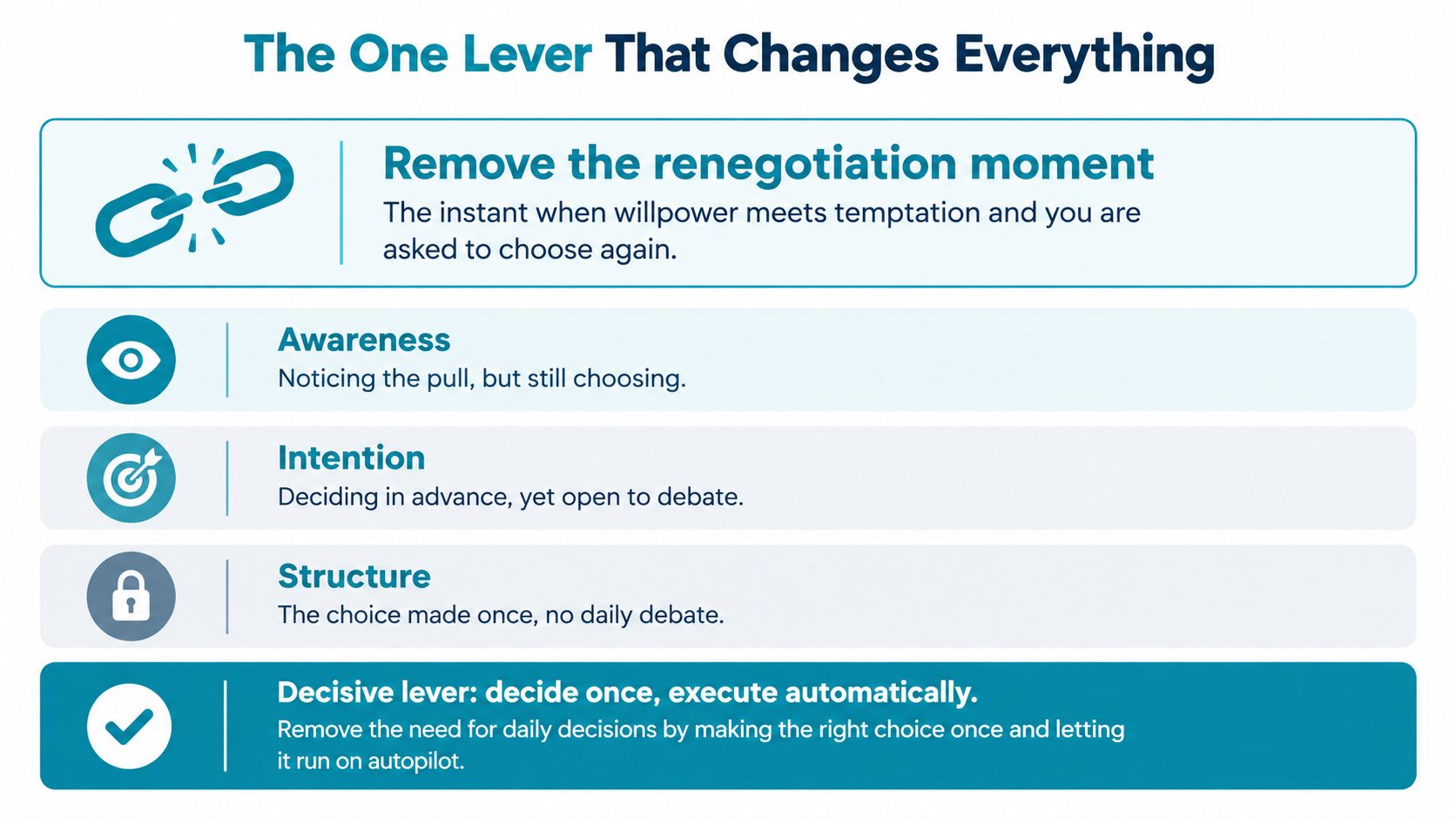
The decisive lever is removing the renegotiation moment.
Awareness notices the pull. Intention makes a promise. Locked execution changes what happens after the temptation arrives. Knowing you should work is cheap. Deciding to work is easy when nothing is at stake. The useful change comes when your distracted self can't casually reopen the app during a defined work window.
Pre-commitment is a decision made by your calm self for your tempted self. It isn't a punishment and it doesn't need to last forever. It creates a temporary barrier long enough for the original plan to survive its first challenge.
Run this today:
- Define one 90-minute deep-work block and name the exact output.
- Choose a lock mode that prevents an easy override during that window.
- Attach the start to an existing cue, such as morning coffee or opening your laptop.
- Review the next morning whether the block held, then adjust the duration or blocklist.
Don't optimize the system before you have used it. If the block fails, identify the escape route. If it feels excessive, shorten the commitment. If you keep forgetting to start, improve the cue. The goal is not a flawless productivity identity. It's a commitment that survives the moment you usually abandon it.
If the off switch is the part that keeps breaking your time-management plans, try TiedSiren to block chosen Android apps for a committed session, with Strict Mode, scheduled sessions, custom blocklists, and a focus timer. Set one work window, attach it to a real cue, and see whether removing the impulsive bypass lets your next block happen.