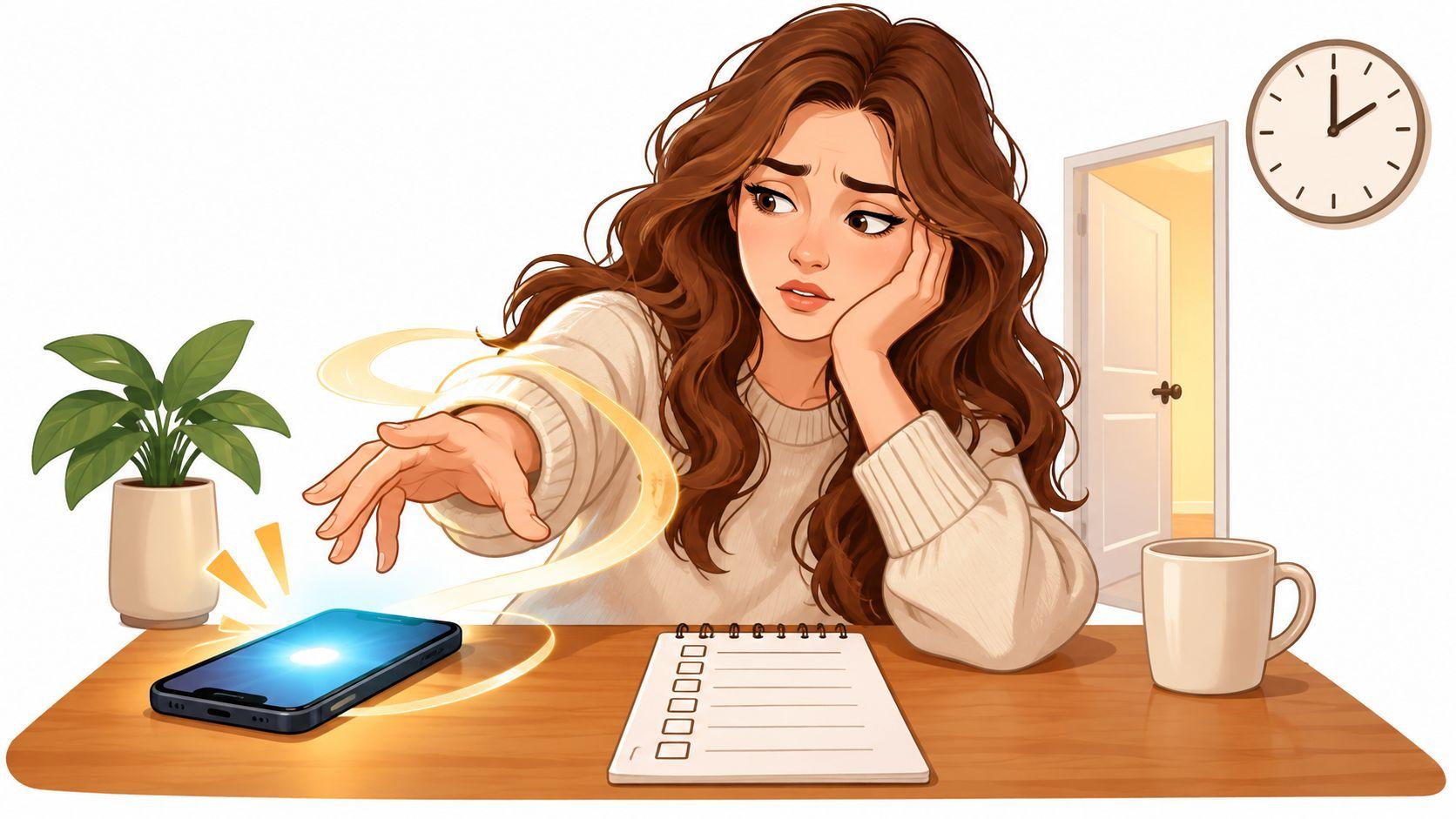
You know the sequence. A session is running, you're three minutes in, and your thumb is already heading for the screen that lets you out. The app opens before you've decided to open it. You didn't plan to break the block. You just did, and afterward you can't point to the second you gave in.
The question "Am I addicted to my phone?" is worth answering properly, because the answer decides what you do next. If your problem is a schedule, a calendar fixes it. If your problem is that your judgment collapses at the moment of the urge, a calendar is a wish.
TiedSiren, the blocker I'll come back to later, runs on Android 8.0 and later. If you're reading this on an iPhone or a laptop, the checklist and the reasoning below apply exactly as written. Only the tool section doesn't.
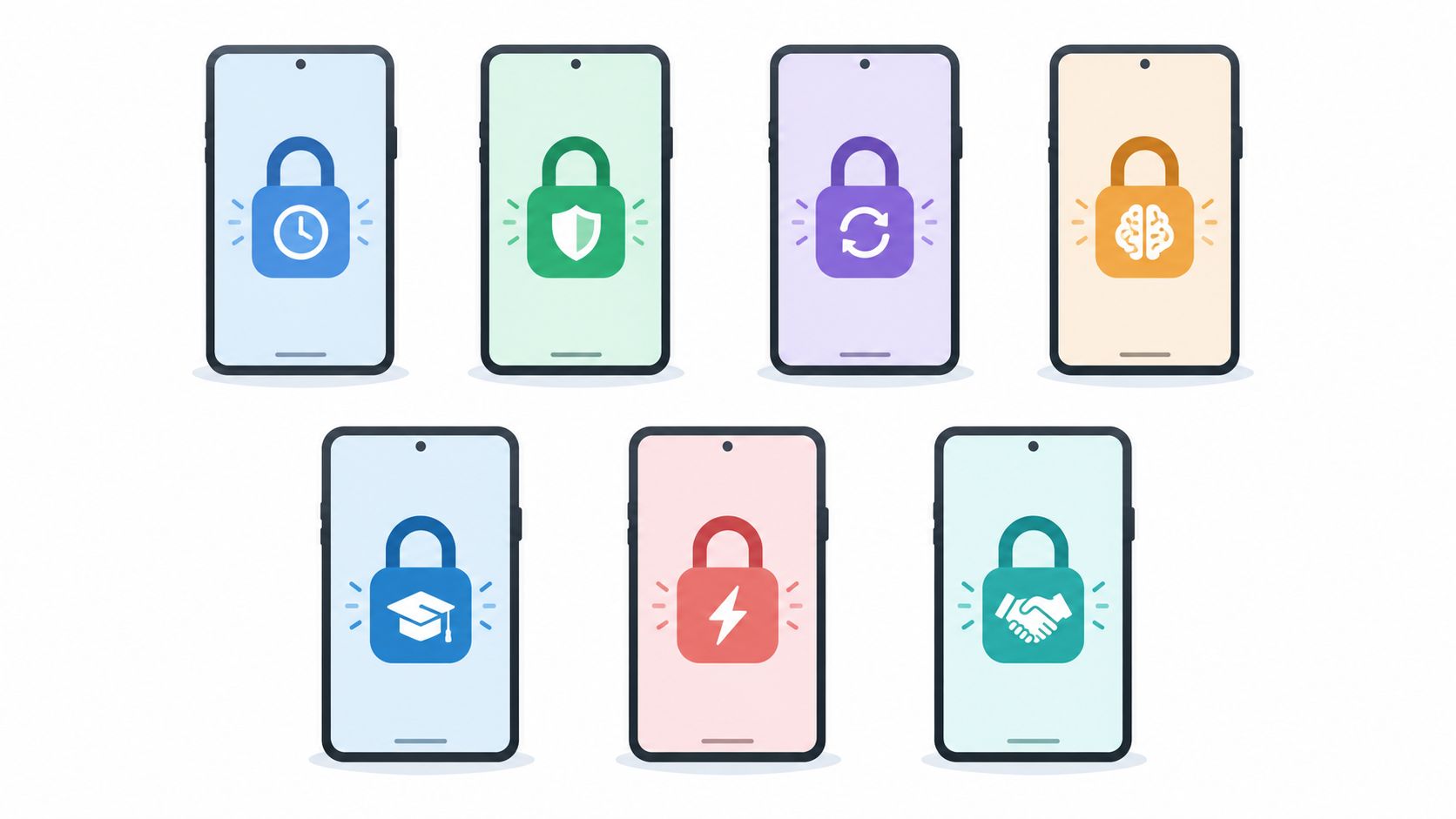
What follows is a set of seven signs with the question each one asks, an explanation of why your hours are a weak measure, what distance from the phone does to your attention, and what changes the outcome when your hand moves.
Seven Warning Signs to Score Tonight
On Monday, you set a limit. By Tuesday, the phone is out and the feed is open before the kettle boils. The session you committed to has ended early. The useful question is what happened when the urge arrived, not how many hours the week added up to.
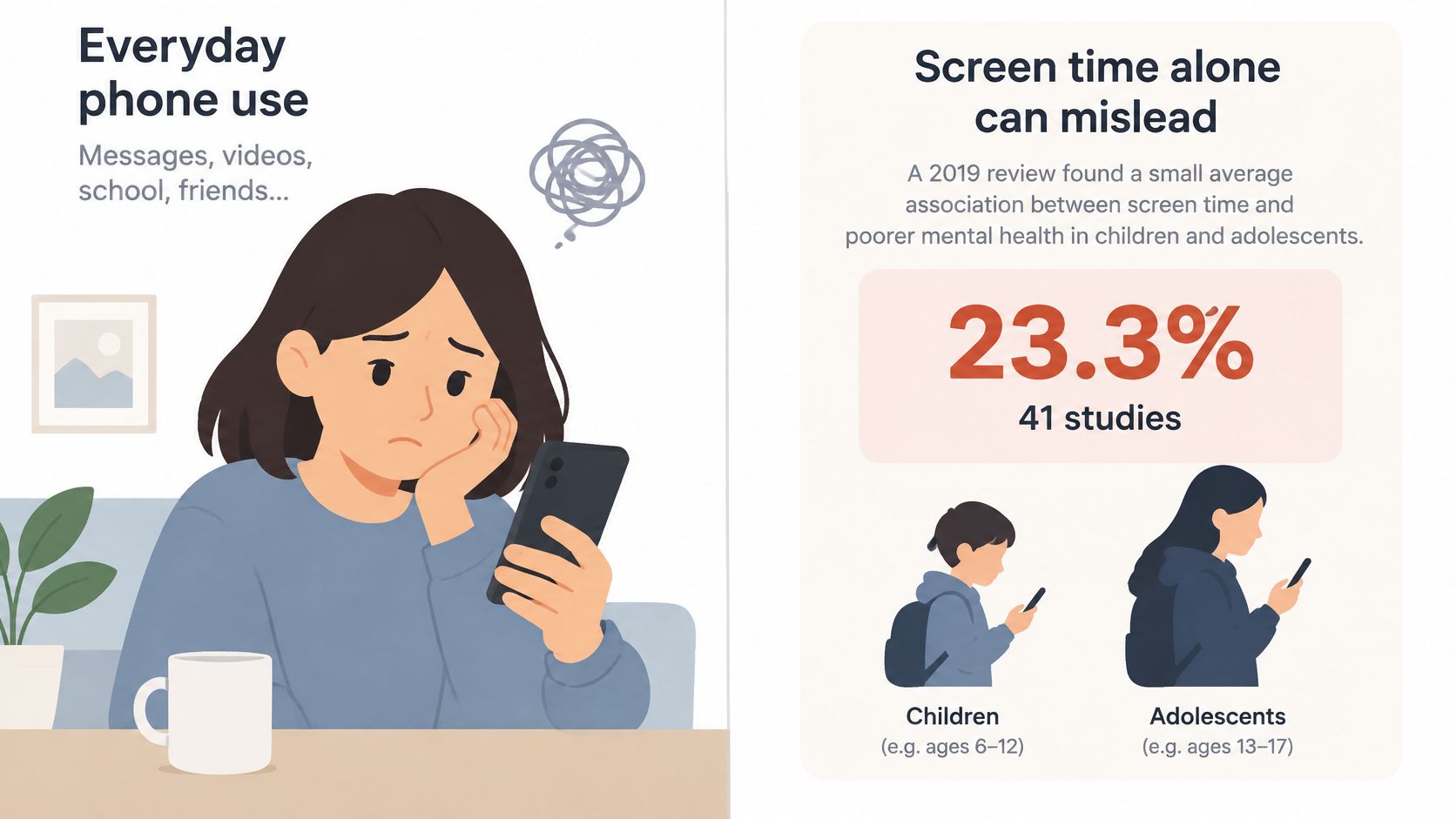
A recurring pattern is worth examining without turning it into a diagnosis. The 2019 systematic review and meta-analysis in BMC Psychiatry, pooling 41 studies of children and young people, found a median prevalence of 23.3%, with an interquartile range of 14.0% to 31.2%. Most individual studies landed between 10% and 30%.
The authors note that measurement tools and definitions varied substantially, so those figures do not establish a universal threshold. Estimates for university students also vary widely, depending on the scale and sample used. Across studies, recurring concerns include difficulty controlling use, unsuccessful attempts to cut down, distress when separated from the device, and disruption to sleep, school, work, or relationships.
The seven signs and the question each one asks
| Sign | What it looks like | Question to ask yourself |
|---|---|---|
| Loss of control | You open an app again after deciding not to | Did I break a limit I set this week? |
| Escalation | You need longer sessions to get the same feeling | Is last month's routine no longer enough? |
| Withdrawal-like discomfort | You feel restless or irritable when the phone is out of reach | Do I feel uneasy after an hour without checking? |
| Neglect of other activities | Sleep, work, or study slips because of the phone | Did I give up sleep or a task for the phone? |
| Continued use despite harm | You keep scrolling after noticing the cost | Did I keep going after I saw what it cost me? |
| Preoccupation | You think about checking when you are not using the phone | Do I plan my next check before I finish the last one? |
| Escape use | You reach for the phone to avoid boredom, stress, or loneliness | What was I avoiding right before I picked it up? |
How to score it without a validated cutoff
No instrument turns these seven signs into a diagnosis. Count the signs that appeared in the last month, then mark those that returned in more than one week. One difficult night after a deadline may be an exception. The same sign appearing across several weeks is a pattern to take seriously.
Give loss of control particular attention if you have already tried setting limits. You decided not to open an app, then opened it anyway. A reminder leaves the choice in your hands at the moment the urge is strongest. A block committed to beforehand adds friction at that moment, which a notification cannot.
A recurring sign is worth more than a month of daily totals.
Why Screen Time Alone Misleads You
A high daily total can reflect work, caregiving, navigation, or time spent on a group chat. A lower total can still include repeated checks that interrupt sleep or make it hard to stop scrolling. Screen time records duration; it does not show whether you could put the phone down when you meant to.
The number of checks during an ordinary day is another useful signal to observe. Notice how often you open the phone without a clear reason, and whether you return to it soon after putting it away. That pattern can show where control slips more clearly than a weekly average.
A fuel gauge can't tell you who's driving
Screen time works like a fuel gauge. It shows how much you used the phone, not whether you were in control of that use.
Two people can finish the week with the same daily total. One checks work messages and puts the phone away at dinner. The other scrolls late at night and keeps going after deciding to stop. Their totals match, but the choices behind them do not.
A total above a friend's average proves little about your own habits. A lower total does not rule out difficulty stopping, either. For guidance on interpreting hours, see what a workable daily screen time limit looks like.
How Distance Changes What You Can Focus On
Nothing needs to happen for an accessible phone to cost you something. In work with nearly 800 smartphone users, participants whose phones sat in another room performed better on demanding cognitive tasks than participants whose phones sat on the desk, with phones in a pocket or bag landing between the two (University of Texas at Austin). The result held whether the phone was powered on or off, and whether it lay face up or face down.
The people who reported the greatest smartphone dependence showed the clearest disadvantage when the device stayed in sight or within easy reach. Holding an urge in check costs attention, and a visible phone keeps submitting the request.
Setups that move the phone out of reach
- Drawer in another room for the length of a study block, so reaching it takes a walk.
- Charger in the hallway overnight, so the last thing you touch before sleep isn't a screen.
- Phone in the car during a work block at home, which turns a two-second reach into a trip downstairs.
- Bag rather than pocket when you can't leave it behind at all, since a covered phone asks less often than a warm one against your leg.
A phone you have to stand up to reach asks a different question than one already in your hand.
Run the one-session test
Do one 45-minute session with the phone in another room, then one with it on the desk. Compare what you finished, not how focused you felt, because the feeling of focus is a poor instrument. Proximity doesn't prove addiction, and none of this shows a phone does damage by itself. It explains why you can finish a session convinced you were concentrating and still have less to show for it than you expected.
Why Taking the Phone Away Feels Like Withdrawal
You start a work block, put the phone away, and reach for it before the task gets difficult. Restlessness, irritability, or a repeated urge to check can make a short break from the phone feel surprisingly uncomfortable. The useful question is what happens at the moment of that urge: can you pause, or does access need to be immediate?
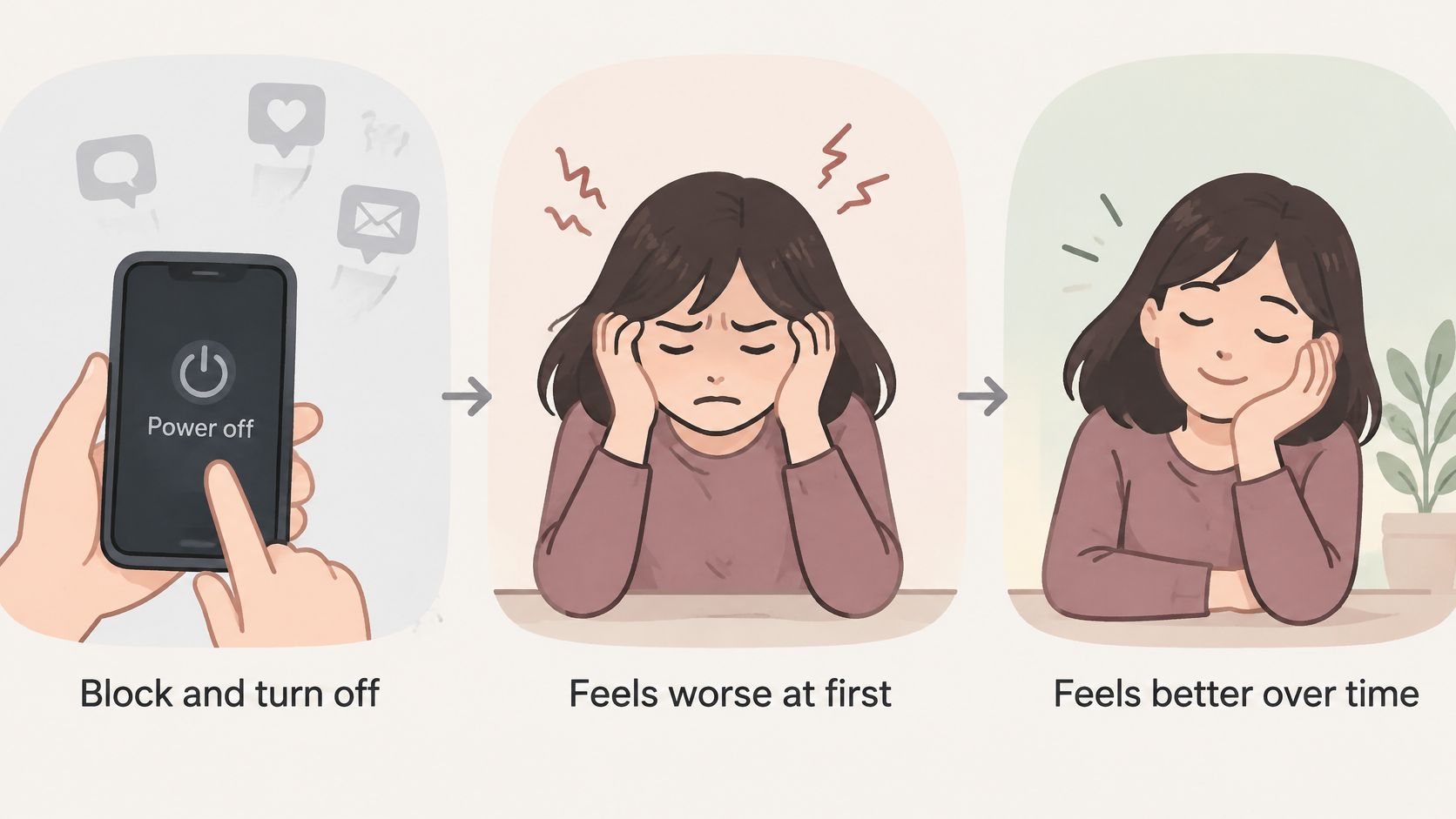
Researchers have studied withdrawal anxiety and inhibitory control around smartphone-related cues in an experimental study in Behaviour & Information Technology. That work examines reactions in a study setting; it cannot establish that every uncomfortable urge is clinical withdrawal or that phone use caused a broader problem.
Large observational studies of adolescents have linked long daily smartphone use with higher loneliness, depressive mood, and perceived stress. Those studies cannot show that phone use caused those outcomes. Discomfort during a block is a signal to examine, not a diagnosis or proof that the block is wrong. It can point to a feeling or task you usually interrupt with a check.
The 60 seconds before you pick it up
Notice the minute before you reach. What were you feeling? What were you avoiding? What task was waiting? Write down the answers for a week. Repeated triggers can reveal whether the urge arrives with boredom, stress, loneliness, or a specific difficult task.
The urge matters most at the moment access feels necessary.
Replace the function, not just the device
If checking gives you a quick break from stress, boredom, or loneliness, taking the phone away removes the shortcut but not the need. Choose a replacement before the block starts: walk around the block, call a specific person, or write down the three tasks you are avoiding.
A firm block adds friction at the moment of the urge. Treat it as an experiment, not a cure: notice whether you can stay with the feeling and return to the task, or whether the same urge keeps interrupting you. The result can help you decide what support or routine would make the next block more manageable.
Four Real Cases and What Each One Needs
A checklist tells you what kind of problem you have. It doesn't tell you which apps to block or when to block them. Here are four common shapes and the setup each one calls for.
In a 2025 six-week observational study published in JMIR Formative Research, 23% of 243 university students met the study's criteria for problematic smartphone use. That's roughly 56 students from one small sample followed for six weeks. It describes that group. It doesn't describe every student, and it doesn't diagnose you.
The student
A second-year revising for exams runs a 90-minute study block, opens a feed between paragraphs, and can't recall what the last ten minutes covered. The sign that fits is loss of control, not high use. Fit: the three or four apps that supply the between-paragraph hit, grouped into a study blocklist, in a 90-minute scheduled session on weekday evenings. Watch after a week whether the block ends the between-paragraph open or whether the habit just finds the gap after the timer.
The developer
A build takes four minutes. Chat gets checked, then a feed, and the afternoon is gone by the time the build finishes. That's preoccupation, planning the next check before the last one ends. Fit: social apps in a work blocklist, sessions aligned with the build and review window, so the gap has nothing in it worth opening.
The adult with ADHD
A mobile game stays open after a stated intention to stop, and the feeling that comes with it is stuck rather than entertained. The best match is continued use despite harm. Fit: games in an evening blocklist, one committed session with the timer visible, so the end of the session isn't a decision you make again at 9 p.m.
The parent
Scrolling in bed after the children are asleep, waking tired, repeat. That's neglect of sleep. Fit: a sleep blocklist with a nightly recurring session that starts 30 minutes before bed and runs until morning, so the boundary is set before you're tired enough to argue with it.
Each case names one sign, not five, because the fix attaches to the failure point. After a week, look at what changed and what didn't. If nothing changed, the sign you picked probably wasn't the one doing the work.
When to Get Professional Help
A checklist and a blocker are tools. Neither is treatment for anxiety, depression, ADHD or anything else that can sit alongside heavy phone use, and a block that keeps failing may be telling you something a block can't fix.
| Situation | Next step |
|---|---|
| Signs from the checklist persist for several weeks despite changes | Book a visit with a general practitioner |
| Sleep, work or study keeps suffering because of phone use | Ask a doctor or counsellor for an assessment |
| Anxiety, panic or low mood appears when the phone is out of reach | Contact a mental health professional |
| Blocks keep failing even with a strict blocker and a fixed schedule | Raise it with a doctor or counsellor and bring your usage notes |
| Thoughts of self-harm or a sense of crisis | Contact local emergency services or a crisis line now |
What to bring to a first appointment
A week of usage notes with times attached. Your checklist with dates on it, so recurring signs are visible rather than remembered. And a list of what you've already tried: which apps you blocked, for how long, and what happened when the session ended. That last part saves time, because it shows whether the problem is access or something underneath it.
A general practitioner is a reasonable first contact in many countries, and counselling is an option where it's available.
What the checklist can't tell you
It can't diagnose a condition. It can't separate ADHD-driven use from anxiety-driven use from ordinary boredom, and it can't rank which habits are hardest to break in your own life, though the habits that are hardest to quit is a useful place to think about that comparison. Bring the notes to a professional and let them do the part the checklist can't.
If you're having thoughts of self-harm or you're in crisis, contact local emergency services or a crisis line now. That step comes before any app, any checklist and any appointment.
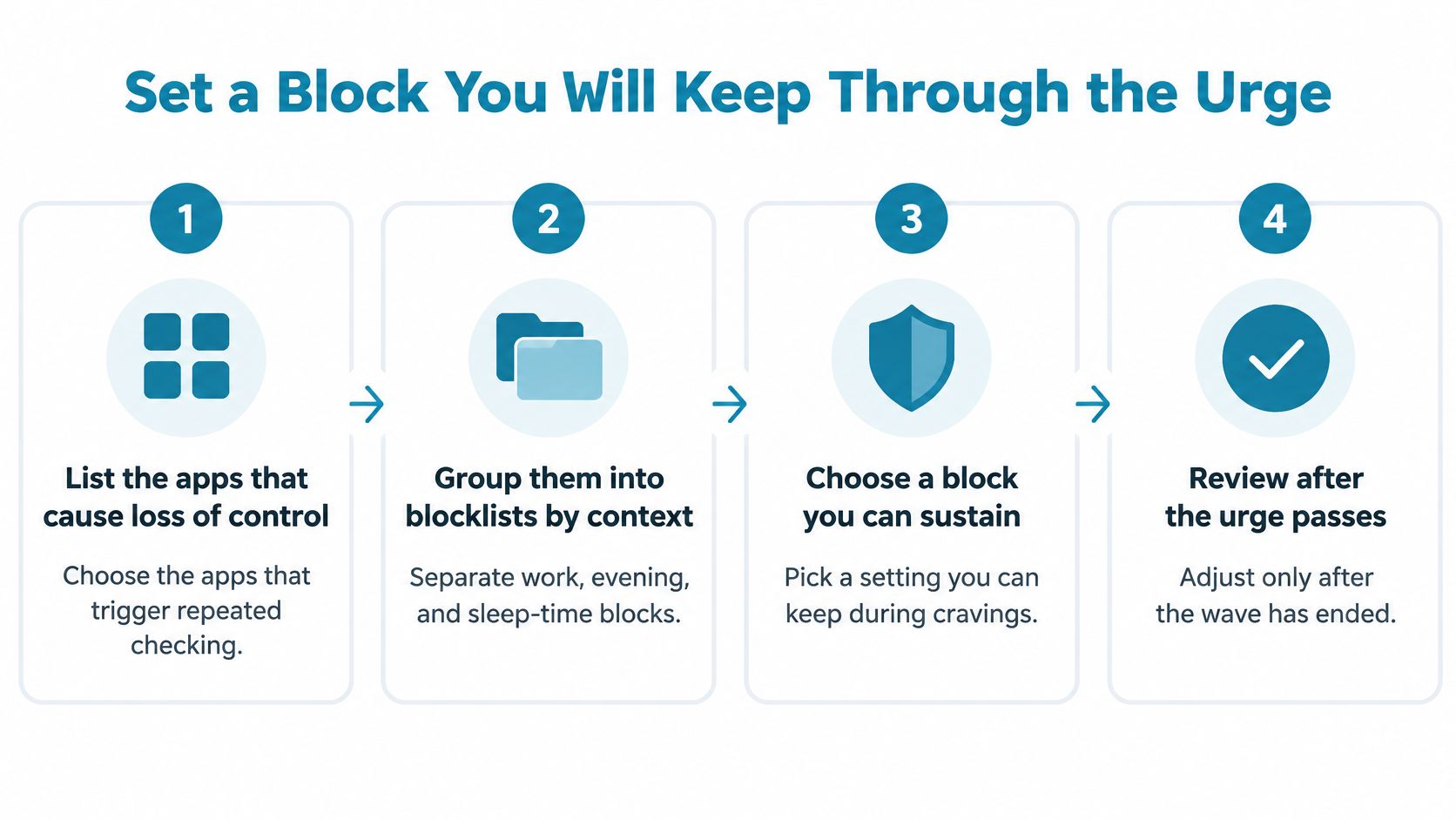
Set a Block You Will Keep Through the Urge
- List the apps that cause loss of control, not every app you use. If a feed never overrides your plans, it doesn't belong on the list.
- Group them into blocklists by context such as work, study and sleep, so a weekend block doesn't inherit a weekday's rules.
- Choose a duration before you start, one you're confident you can finish. A 45-minute session you complete beats a four-hour one you break at minute twelve.
- Start the session in Strict Mode. Strict Mode locks a session for a duration chosen before it starts, and the session can't be shortened from the phone once it begins.
- Turn on the optional Settings lock before the timer starts. It keeps the Settings app closed until the timer ends, including the Wi-Fi, Bluetooth and permission screens, which raises the cost of switching the block off mid-urge.
- Watch the focus timer for time left, so the end of the session is something you can see rather than something you renegotiate.
- Set a scheduled session to recur daily or weekly if the same window catches you every time.
Phone calls and emergency services are never blocked during a session, which is the one thing that has to stay true.
Where the friction ends
Strict Mode defeats the impulsive bypass, the one done in seconds without premeditation. That's a real limit rather than a modest one, and it's also where the honesty starts. Someone determined, with time and a second device, can get around any Android blocker, TiedSiren included.
AppBlock, BlockSite, Cold Turkey and Stay Focused all block solidly. The difference here isn't stronger blocking. It's that a running session offers no override to find.
If you already turned a block off
Restart the same blocklist at the same duration instead of designing a new system. Then write down which sign from the checklist appeared at the moment you disabled it. That name is the useful output of this whole exercise, because it tells you which window to protect next.
One block this week: pick your worst hour, one blocklist, one duration, and run it for seven days. Review the checklist on day seven and change one thing. If you want to work on the impulse itself, how to improve impulse control without relying on willpower covers the part a block can't reach. When you're ready, install from Google Play or tiedsiren.com/download.
TiedSiren does one job: it holds you to a decision you made before the urge arrived. You choose the apps, commit to a duration, and the session runs to its end with no pause and no override, which is the piece most blockers leave open at the worst moment. If you've caught yourself disabling a block right when it mattered, that failure is exactly what it's built for. Visit TiedSiren to see how Strict Mode and scheduled sessions work.