The betting app is still on the home screen, and a browser tab still loads the site. You already installed a blocker. On the night it mattered, you turned it off. A gambling blocker app only helps if it changes that moment, and only for the routes it covers.
TiedSiren runs on Android phones, on Android 8.0 and later. If you are on an iPhone or a desktop, the product details here do not apply to your device. The map of what a block misses still does.
What a Gambling Blocker App Can and Cannot Stop
A gambling blocker app touches one layer at a time. Installed apps, browser addresses, a network filter, a self-exclusion register, and a card block each close a different door. None of them closes the rest.
| Layer | What it stops | What it misses |
|---|---|---|
| Installed betting apps on the phone | Listed apps stay closed for the session | Browser access to the same site and apps not on the list |
| Websites in supported browsers | Listed addresses close when opened | Mirror domains, new addresses and unlisted sites |
| Network or DNS filtering | Reduces access across a connection | Overblocks shared IP addresses and is bypassed with VPNs or mirror sites |
| Self-exclusion registry such as GAMSTOP | Stops registered users at participating UK operators | Offshore operators, non-participating operators and other devices |
| Card or bank gambling block | Stops card payments routed to gambling merchants | Other payment methods and accounts not covered by the block |
App blocking covers the apps you named. Open the same bookmaker in a browser, or an app you left off the list, and that route is still there.
A website list closes the addresses on it. A mirror domain, a fresh address, or a site you never added is a different door.
Network filtering is weaker than it looks. A technical review of blocking measures found that IP-based blocking can reduce access, and that it can overblock, because legitimate services and gambling services may share one IP address. The same review reports that determined or technically skilled users can route around network restrictions with VPNs, IP-address changes, mirror sites, or other offshore providers.
GAMSTOP stops you at participating UK-licensed operators. An offshore site, an operator outside the scheme, and a second phone are outside that register.
A card or bank block declines card payments that the bank codes as gambling. A transfer, another wallet, or a card you did not put the block on can still fund a bet.
Plan for the open door, not for the door you already closed.
Treat the blocker as one layer. The gaps are the part you have to plan for.
What Research Says About Committing in Advance
A reminder arrives while you want to bet. A commitment is made before that want shows up. Those are different tools, and they fail in different places.
Pre-commitment means setting a limit, or excluding yourself, before gambling begins. A clinical review of gambling-harm interventions reports that mandatory pre-commitment has more empirical support, while findings for voluntary systems are inconsistent. The same review notes that some blocking software can block up to 99% of gambling sites, including offshore provision, and that implementation decides whether that figure means anything on a real phone.
What the GAMSTOP numbers do and do not prove
The United Kingdom's GAMSTOP, launched in 2018, is the clearest large example of deciding in advance. An independent 2021 evaluation surveyed more than 3,300 registered users. 82% reported either stopping gambling or gambling less on UK gambling websites after registration, and 80% said the scheme delivered its intended outcome, according to the GAMSTOP effectiveness report.
Both figures are what people said happened. They are not proof that every blocker prevents gambling, and they are not proof that relapse stops.
GAMSTOP applies across participating operators. A phone blocker does not inherit that coverage. You have to name the betting, casino, lottery, and payment-related apps yourself. A fixed session that repeats on a schedule is a pre-commitment over that list. It is not a popup you can dismiss when the urge is already loud.
Make the limit while you still disagree with the urge.
Calm is the useful window. Once the urge is here, you are negotiating with a person who wants the block gone. If the impulse is the part that keeps winning, work on how to improve impulse control beside the block, not instead of it. The block only holds the apps you already listed, for the stretch you already chose.
Why the Off Switch Decides Whether a Blocker Works
It is 11 p.m. The urge is here. The block you set this afternoon can be ended in a few taps. That earlier decision is what the urge is now testing.
Most write-ups score a blocker by how many domains it lists. The useful test is what you do when you try to end it.
| Finding | Figure | Source |
|---|---|---|
| Blocking-software users who reported a breach | 39% of 156 users | 2026 international survey, Springer |
| Mean breaches among users who breached | 12.3 breaches, about 4.7 per month | 2026 international survey, Springer |
| Players who returned to gambling after exclusion ended or was bypassed | 1,382 of 3,203 (43.1%) | 2023 peer-reviewed study of British online casino players |
| Players who returned after choosing short-term exclusion | 1,370 of 1,820 (75.3%) | 2023 peer-reviewed study of British online casino players |
| Gamblers saying management tools reduced time or money spent | 82.6% (2025) | UK Gambling Commission data, as reported in the 2026 survey paper |
Short blocks and actual breaches
A 2026 international survey of 156 blocking-software users found that 39% reported breaching their software, by visiting unblocked sites or bypassing the tool. Among those users, the mean was 12.3 breaches, about 4.7 a month. Breaching is ordinary, not a rare failure.
A 2023 study of British online casino players followed 3,203 people who used voluntary self-exclusion between January 2021 and August 2022. 1,382 of them, 43.1%, returned to gambling during the study after exclusion ended or was bypassed. Among the 1,820 who chose short-term exclusion, 1,370, or 75.3%, started gambling again in the observation window. The researchers concluded that short-term voluntary self-exclusion may be less effective than longer-term exclusion.
The same 2026 paper reports 2025 UK Gambling Commission data in which 82.6% of gamblers who used management tools said those tools reduced the time or money they spent. That is a real reported reduction. It is not the same as a block that held on the night someone tried to undo it.
The 2026 analyses tied stronger recovery associations to social support. Blocking duration and breach frequency were not significant predictors. A longer block and a clean record are not, by themselves, what predicted recovery in that model.
A blocker you can switch off in three taps is not a commitment device.
A countdown-only exit keeps the decision you made earlier. A one-tap exit gives it back at the worst minute. If you get through, write down the route, whether that was another device, a mirror site, or a short timer you waited out. Then close that route before the next session. A slip is a plan item, not a verdict on the whole tool.
Five Criteria for Comparing Blocker Apps
Run these checks on any blocker before you install it. The list is the comparison. A polished feature page is not.
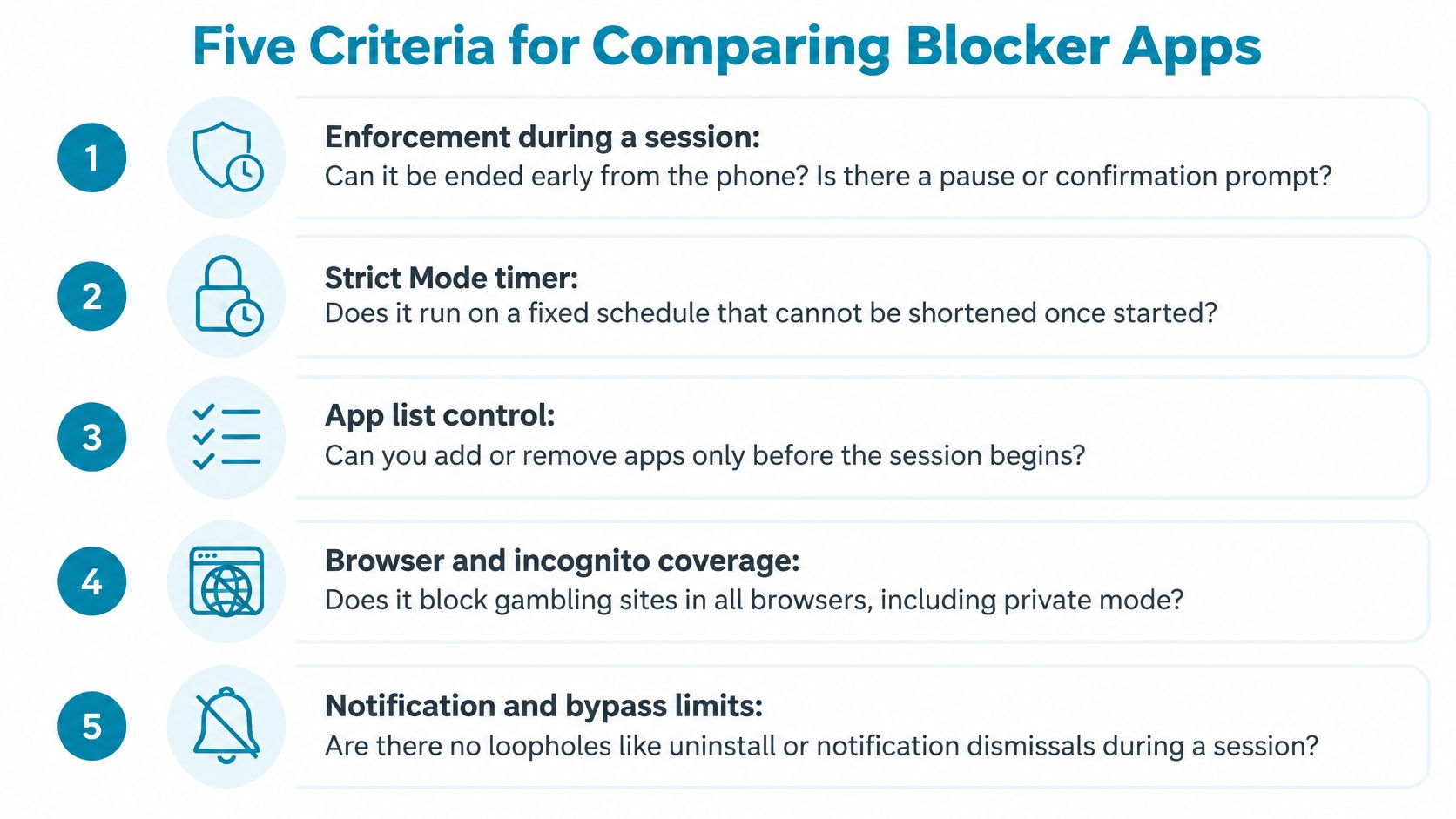
- Enforcement during a session. Find out whether the session can be ended early from the phone, and whether a pause or a confirmation prompt lets you through. A countdown-only exit holds better than an exit that is one tap away.
- Settings and uninstall locks. Check whether the blocker keeps the Settings screen closed and whether it can be removed before the timer ends. The reason that lock matters is the next section, so do not take a marketing line as the answer.
- Browser coverage. Confirm the blocker closes gambling sites in each browser you use, not only in the one named on the store listing. A block that ignores your second browser is a block with a hole.
- Blocklist control. You should be able to add apps and sites by name or address, and group them into lists such as Work, Sleep, and Study. One giant list is hard to keep honest.
- Scheduling. Daily or weekly sessions should start without you doing anything that day. If the block waits for you to remember, you will forget it on the day you need it.
Two extra checks sit beside those five. Ask what happens with no signal. An internet connection is needed once to create the account, after which blocking works offline, and losing signal changes nothing about a running session. Also ask whether a session can start with no card on file. Blocking apps, blocklists, and scheduled sessions is free, with no credit card required.
For a wider pass over the same checks, the comparison of Android app blockers is the place to line products up before you commit a night to one of them.
How a Session Lock Holds Once It Starts
The order is the whole mechanism. Choose the duration before the session starts. Put the apps on the list. Start the session. After that, the phone should stop offering you a deal.
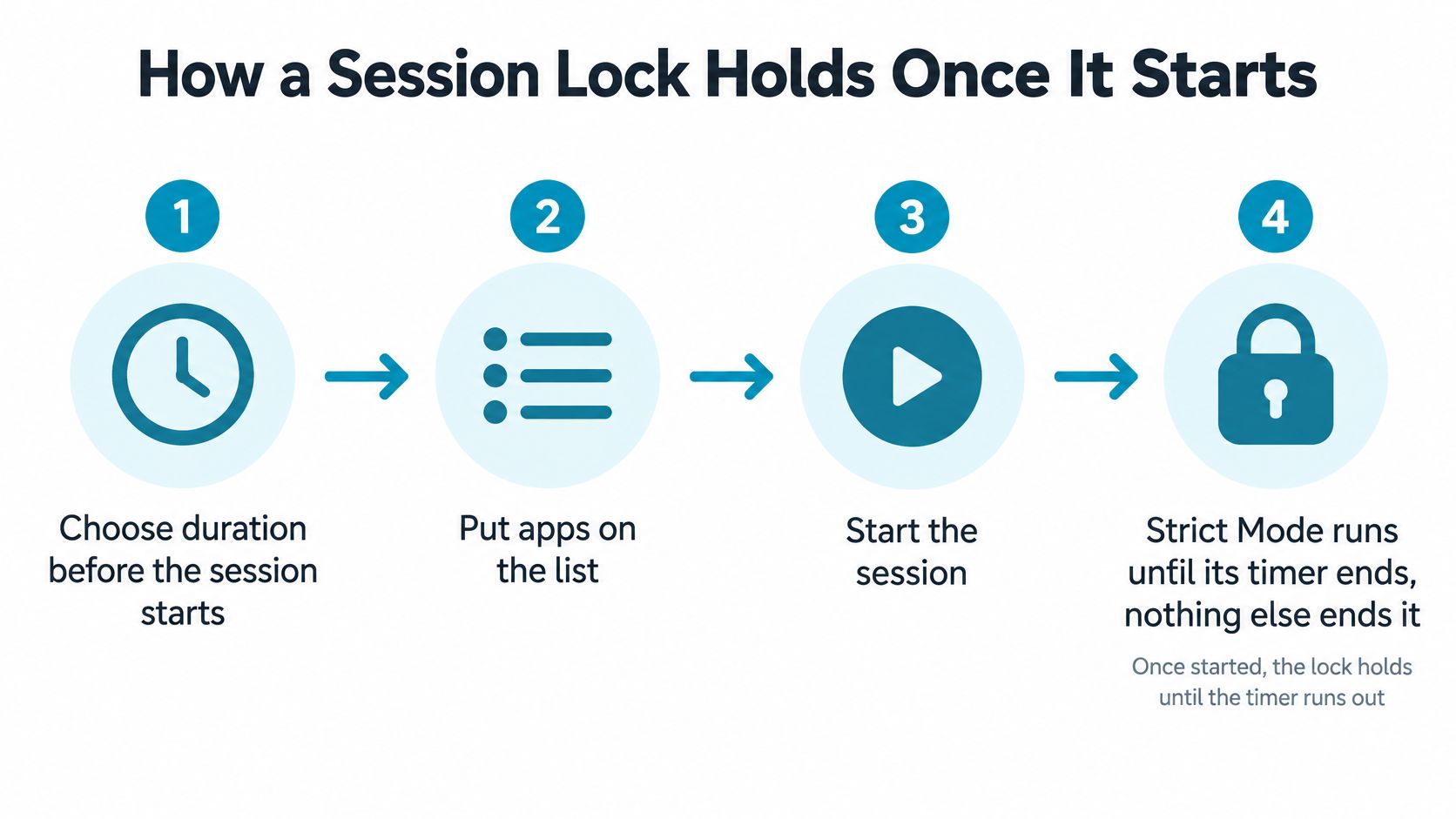
Strict Mode ends when its timer ends, and nothing else ends it. The timer cannot be cut short from the phone while the session runs. Listed apps stay closed. A focus timer shows the time left, so you can see the window instead of guessing it.
What the Settings block changes
While a session runs, the Android Settings screen stays blocked. That raises the cost of turning the blocker off, because app permissions are changed in Settings. Android's app security documentation says an app must declare the capabilities it needs, the system can ask you to allow or deny access, and you can inspect permissions in device Settings and turn some functionality off. Closing that screen removes the fastest path to those controls.
This defeats the impulsive bypass, the one done in five seconds without premeditation. A determined person with deeper technical access can still get past it. The lock is friction against a sudden undo. It is not a claim that the phone is sealed.
The lock lasts the length you chose, so that length has to be set before the urge arrives. Pick a stretch you can finish. The same idea, applied to keeping one app in front of you, is covered in how an Android lock holds an app on screen.
Choosing a Blocker by Your Situation
A student revising on an Android phone is one situation. A night when betting sites are one search away is another. The blocker you pick has to match the route you use to undo it.
Students need a session that cannot be cut short from the phone, plus a schedule that starts for study hours without a fresh decision. A block you re-arm every evening loses to a revision break.
Developers and other knowledge workers need lists that switch by context. A Work list, a Sleep list and a Study list are different problems. One list for the whole day either blocks too much or blocks the wrong apps at night.
People who already disabled a blocker
If you have already turned a blocker off at the wrong moment, you need a session with no override. The Settings lock matters most here, because that screen is the usual undo. An optional uninstall lock stops the app being removed until the timer ends. A reminder you can dismiss is the tool you already beat.
If the habit is betting, pair the session with formal self-exclusion where a scheme exists, such as GAMSTOP for participating UK operators, and with a card or bank block. The phone only covers the apps and sites you listed. Offshore operators, mirror domains, and a second device sit outside that list. Closing one app does not close those routes.
TiedSiren holds a running session with no in-session override. The timer you set is what ends it. The app runs on Android 8.0 and later. iPhone and desktop readers need a tool built for their own platform.
A session length you can keep matters more than a long one you will abandon.
I would start with the shortest stretch you will still be glad you set when you are calm, then repeat it. A heroic overnight block that you tear down once teaches the wrong lesson.
Decide Your Block Length Before You Install
The decision that matters is made before any urge. How long does the first session run, and which apps go on the list? Set both while you still want the block to win.
- Write the list down. Name every betting, casino, lottery, and payment-related app you have used, including the one you only open "to check a score."
- Pick a length you can keep when you are not tempted. If you would resent a six-hour block on a normal afternoon, do not set six hours for the first night.
- Schedule the risky hours. Use a daily or weekly recurrence for the stretch when the urge is strongest, so the session starts without a manual tap that day.
- Check the browsers you use. Confirm the blocker covers each of them. A second browser is a common way around a list that only watches one.
- Register with a scheme if your country has one. A device blocker does not reach every route. Self-exclusion covers participating operators. The phone covers the apps you listed.
TiedSiren is a free Android app for Android 8.0 and later. Install it from the Google Play listing or from the download page. Build the list, set the length, and start the session before the urge has a vote.
A blocker reduces impulsive access. It does not replace professional support.
TiedSiren is a free Android app that blocks the apps you choose for a duration you commit to up front, with Strict Mode so a running session ends when the timer ends. If a gambling blocker app has already failed you because it was easy to switch off, that committed session is the part worth testing. Visit TiedSiren and set the first block while you still mean it.